What Will Your Future Baby Look Like? Try AI Prediction
By Maria · 2026-08-22
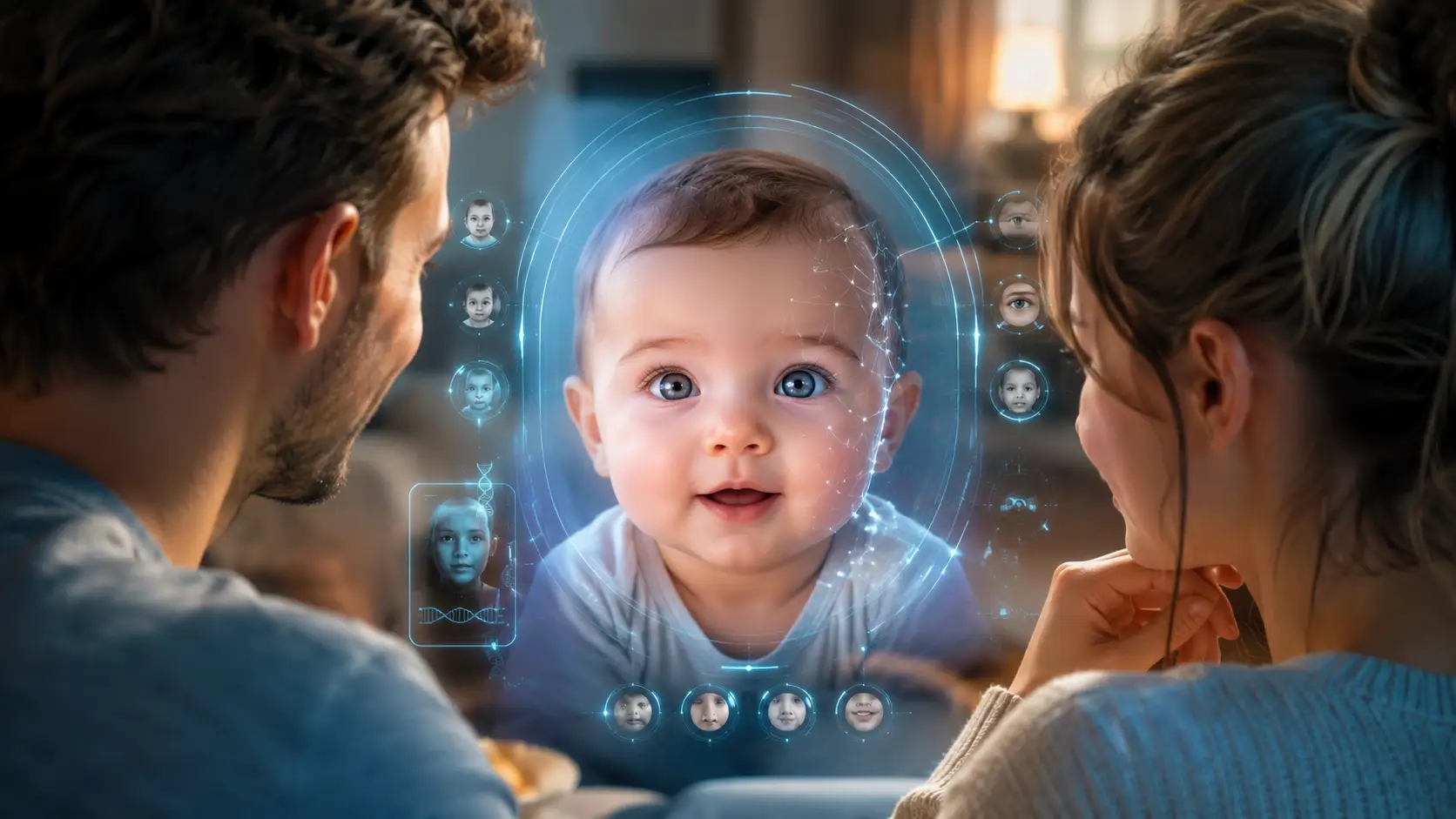
Curious what your future baby might look like? Learn how AI baby generators use parents’ photos, what genetics can reveal, and how accurate these predictions really are.
There is something deeply human about wondering what your future baby will look like. Will your baby have your eyes, your partner’s smile, or a surprising mix of both? For many people, that question is more than curiosity. It is part excitement, part imagination, and part hope.
That is where an AI baby generator comes in. These tools use photos of two parents to create a visual idea of what a future child might look like. They can be fun, emotional, and surprisingly detailed. But one thing is important to understand from the start: an AI baby generator creates a visual possibility, not a scientific prediction. It does not read DNA, and it cannot know exactly how a real baby will develop.
So, how much can genetics really tell us, and how much is AI simply imagining?
Summary
Wondering what your future baby might look like? AI baby generators can create a fun visual estimate using parents’ photos, but they cannot predict a child’s exact appearance. This guide explains what genetics can tell us, how AI baby prediction works, and how much you can really trust the result.
What Will Your Baby Actually Look Like? Genetics Has Some Clues
The short answer is that your baby will inherit genetic material from both biological parents, but appearance is not built like a simple 50/50 face blend.
According to the National Human Genome Research Institute (NHGRI), most human cells have two copies of the genome, with one copy inherited from each parent. That means a child gets roughly half of their DNA from each biological parent. But 50% of your genome from each parent does not mean 50% of your visible appearance from each parent.
Visible traits can be influenced by inherited factors such as:
Eye color
Hair color and texture
Skin pigmentation
Face shape
Nose shape
Lips
Jawline
Height
Some of these traits are influenced by several genes at once, which is one reason children can resemble both parents in different ways rather than looking like a clean split of either one.
Will Your Baby Look More Like Mom or Dad?
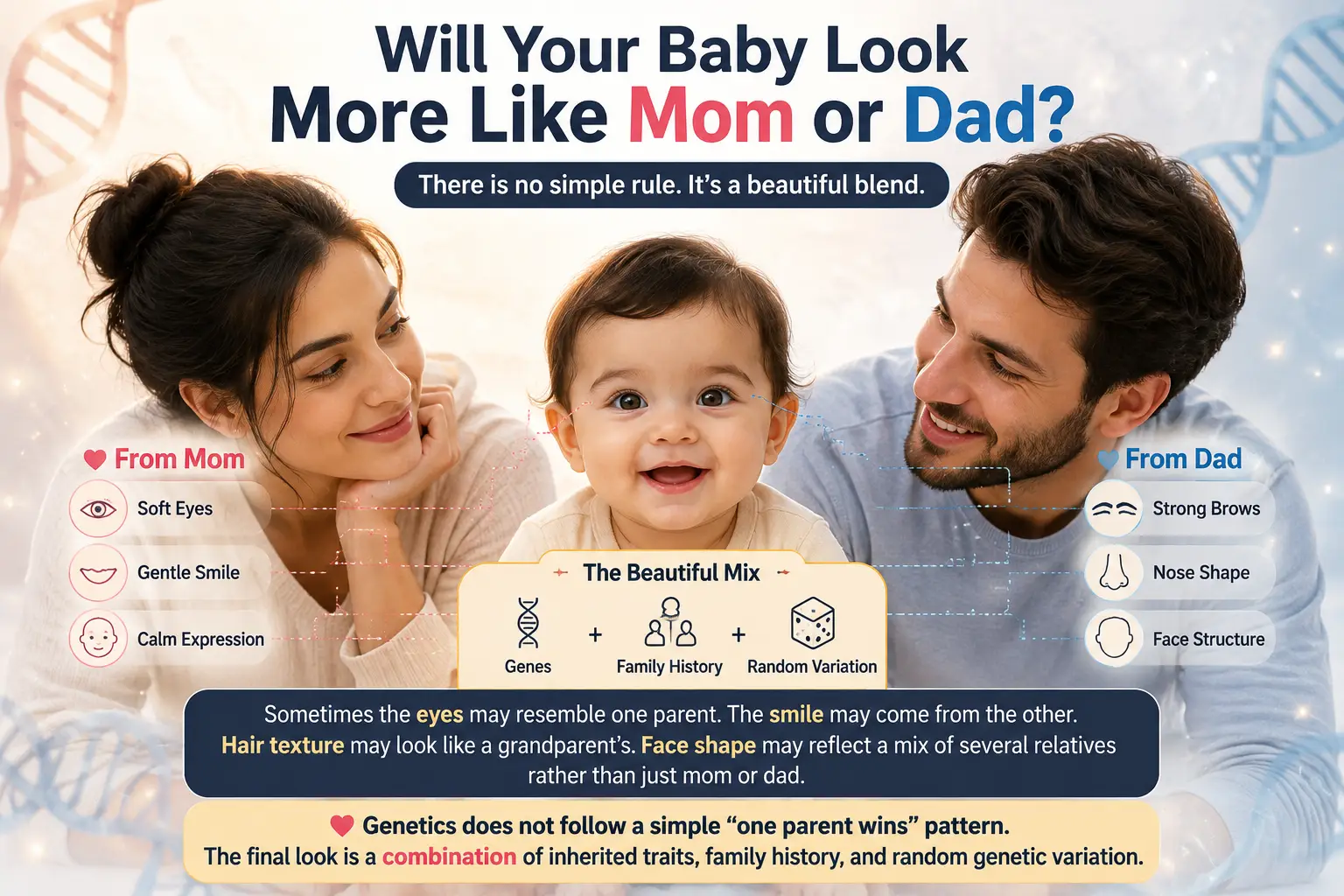
This is one of the first things people ask when imagining a baby, but there is no reliable rule that says a child will look more like one parent.
Sometimes the eyes may resemble one parent. The smile may come from the other. Hair texture may look like a grandparent’s. Face shape may reflect a mix of several relatives rather than just mom or dad.
That is what makes a baby's appearance so interesting. Genetics does not follow a simple “one parent wins” pattern. The final look is a combination of inherited traits, family history, and random genetic variation.
Why Your Baby Might Look Nothing Like You Expected
Sometimes children inherit combinations of genetic variants that create features no one in the family seems to have in an obvious way.
A few reasons this happens:
Multiple genes influence one trait: many physical features are polygenic, not controlled by a single gene.
Recessive traits: traits can appear from hidden genetic combinations.
Extended family genetics: a baby may resemble a grandparent, aunt, uncle, or even a more distant relative.
Random genetic combinations: inheritance is not a perfect visual formula.
This is why a baby can still surprise both parents, even when family traits seem predictable on paper.
So, Can AI Really Predict What Your Future Baby Will Look Like?
Not exactly.
An AI baby generator does not know your child’s actual DNA. Instead, it analyzes the visible features in parent photos and generates a new image based on patterns it has learned from visual data. In other words, it is creating an AI-generated possibility, not a genetic forecast.
That distinction matters.
AI image generation is based on visual patterns.
Genetic prediction would require real biological information the tool does not have.
So when you ask, “can AI predict what my baby will look like?” The most accurate answer is: it can create a realistic guess, but not a scientific certainty.
How Does an AI Baby Generator Turn Two Faces Into One?
AI baby generators work by processing visual data through complex algorithms that identify and merge specific facial markers. Think of it as a creative digital collage that calculates how key features from two parents might coalesce into a new, unique face.
1. Start With Clear Photos of Both Parents
The better the input photo, the better the result.
Good photos usually have:
A clear face
A front-facing angle
Good lighting
Minimal filters
No sunglasses or major obstructions
2. AI Analyzes Visible Facial Features
The model looks at features such as:
Face shape
Eye shape
Nose
Mouth
Facial proportions
Skin appearance
Hair appearance
3. The Model Generates a Possible Baby Face
The final image is not a real baby photo. It is a newly generated visual interpretation based on the two uploaded faces.
How Accurate Are AI Baby Generators?
There is no universal accuracy percentage for AI baby generators, and it would be misleading to invent one.
Why? Because these tools do not have access to the baby’s actual DNA. Many appearance traits are influenced by multiple genes. Genetic combinations are unpredictable. A child’s features also change as they grow. On top of that, different AI models can produce different results from the same photos.
A useful scientific framing from NHGRI is that a child inherits one copy of the genome from each parent, but that does not make appearance predictable in a simple way. Genetics provides clues, not a finished portrait.
So the best way to think about AI baby generators is this: they are fun, creative, and often surprisingly convincing, but they are not medical or genetic prediction tools.
Which Features Can AI Baby Generators Get Surprisingly Close To?
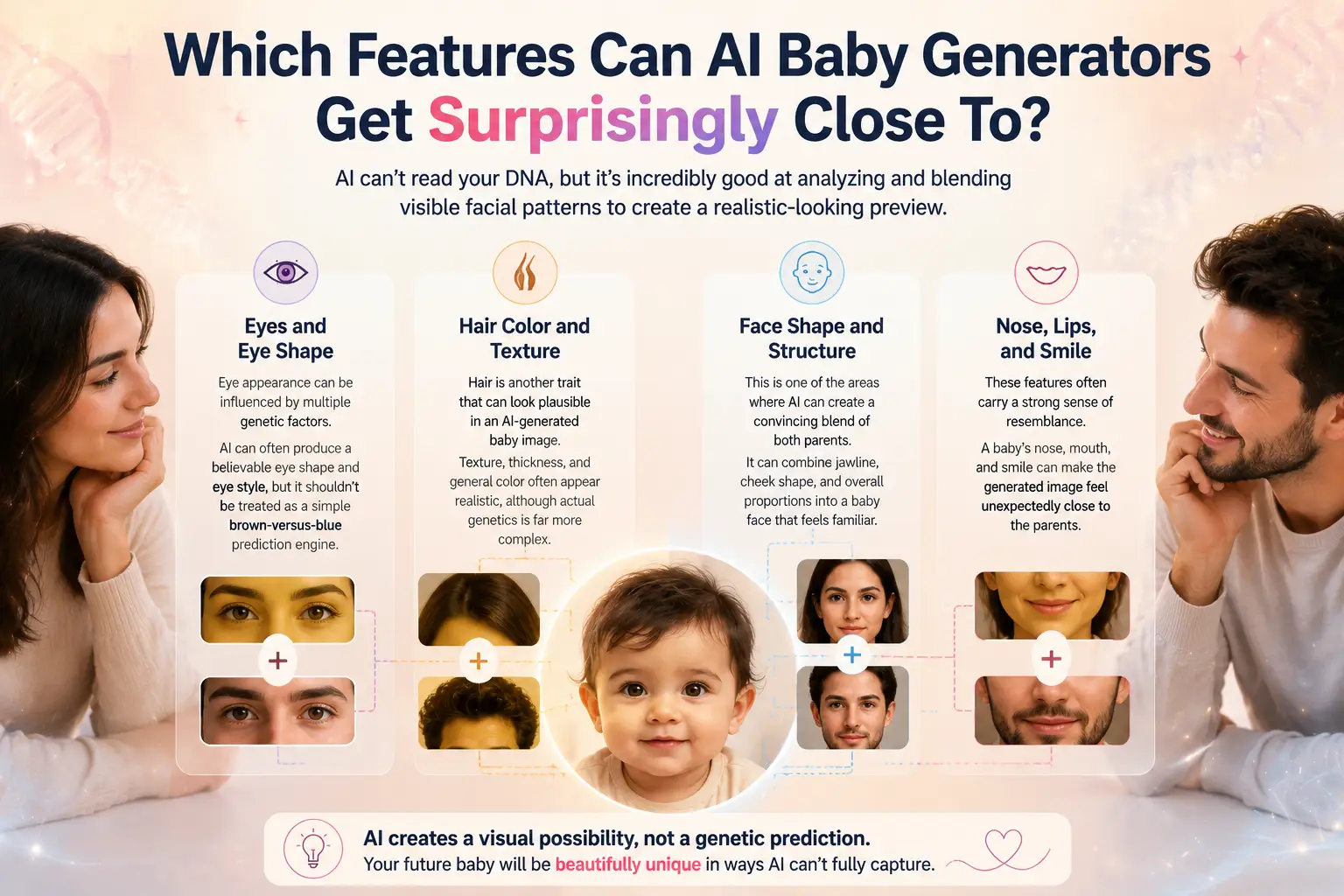
While AI tools cannot decipher your unique DNA, they are remarkably effective at analyzing and blending visible facial patterns. Here are the key physical traits where AI-generated previews often produce a surprisingly plausible resemblance:
Eyes and Eye Shape
Eye appearance can be influenced by multiple genetic factors. AI can often produce a believable eye shape and eye style, but it should not be treated as a simple brown-versus-blue prediction engine.
Hair Color and Texture
Hair is another trait that can look plausible in an AI-generated baby image. Texture, thickness, and general color often appear realistic, although actual genetics is far more complex.
Face Shape and Structure
This is one of the areas where AI can create a convincing blend of both parents. It can combine jawline, cheek shape, and overall proportions into a baby face that feels familiar.
Nose, Lips, and Smile
These features often carry a strong sense of resemblance. A baby’s nose, mouth, and smile can make the generated image feel unexpectedly close to the parents.
Want a More Realistic AI Baby? Your Photos Matter More Than You Think
If you want a more realistic baby prediction from parents’ photos, the quality of the images you upload can make a big difference.
Choose clear, front-facing photos: Use images where both faces are easy to see and facial features are not hidden.
Use similar angles and lighting: Photos taken from similar angles and in balanced lighting can help the AI compare facial features more consistently.
Skip heavy filters and face-altering edits: Beauty filters, strong retouching, and other edits can change facial details and make the result less natural.
Keep both faces fully visible: Avoid photos where hair, hands, sunglasses, deep shadows, or other objects cover important facial features.
imp:For the best results, use clear, natural, well-lit, and unobstructed photos of both parents.
How to See What Your Future Baby Might Look Like With Betatum AI
If you want to explore what your future baby may look like, Betatum AI gives you a fun and visually engaging way to try a future baby generator from photos. It is designed for people who want to see a realistic AI baby face predictor result based on two parent images.
Just remember the key distinction: this is a baby prediction from parents’ photos, not a scientific answer. It is a creative preview of possibility, not a DNA-based forecast.