
What Hair Color Suits You Best? See It Before You Dye
By Parisa · 2026-09-06
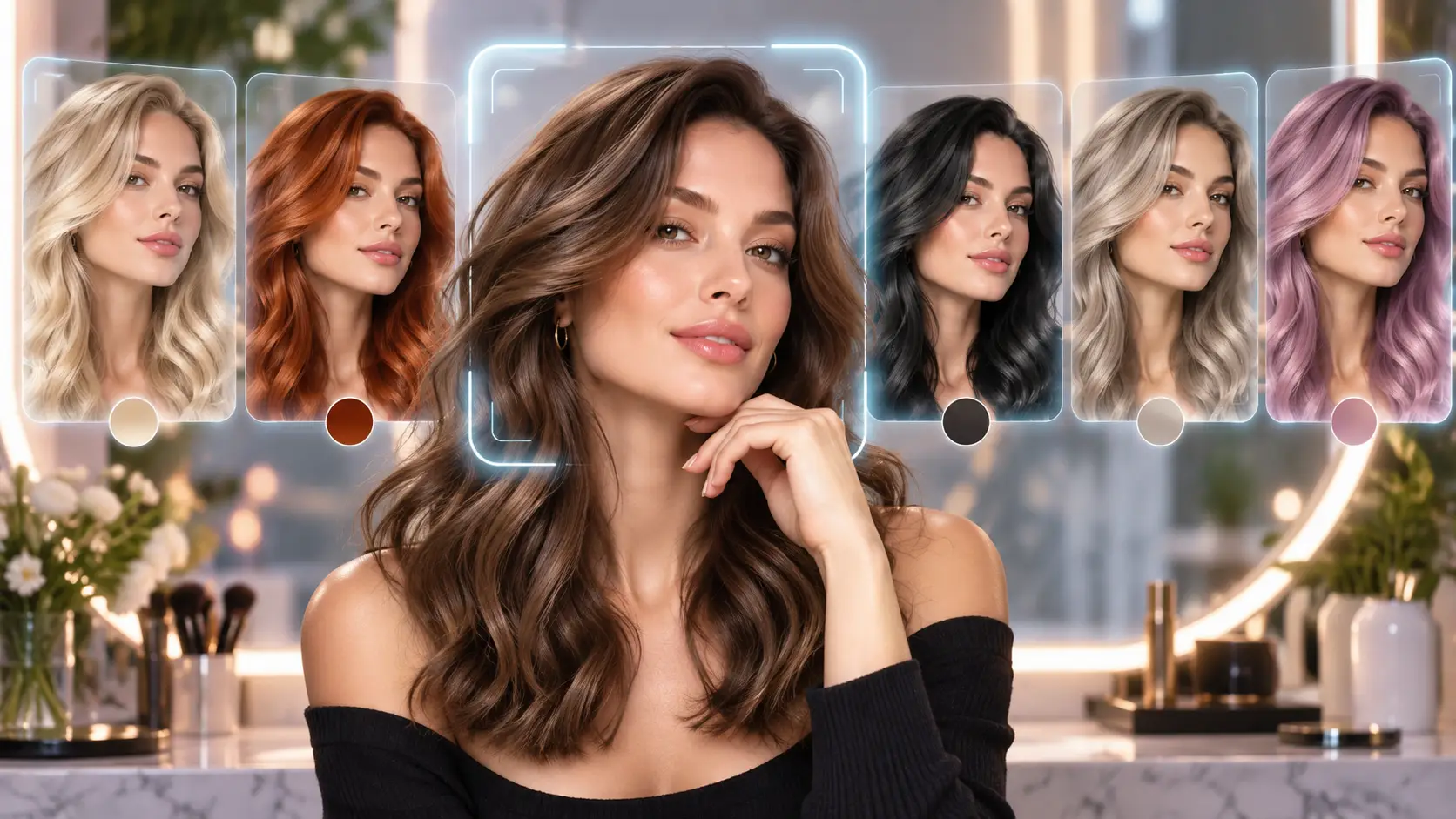
Find the hair color that suits you best based on undertone, contrast, eye color, current hair and upkeep—then preview your top shades with AI before dyeing.
Open with a relatable question: a copper, espresso brown, or icy blonde may look perfect in a photo, but will it look just as good with your skin tone, eyes, and natural features?
Explain briefly that there is no single perfect hair color for everyone. The best choice depends on factors such as skin undertone, facial contrast, eye color, current hair color, hair condition, and how much maintenance the reader wants. Use “what hair color looks best on me” naturally within the first 100 words.
Introduce AI hair color preview as a practical way to see different shades on your own face before dyeing, instead of relying only on swatches, inspiration photos, or celebrity looks.
Avoid generic openings such as: “Hair color is an important part of your appearance.”
summary
The hair color that suits you best depends on more than skin tone. Your undertone can guide the color direction, while facial contrast, eye color, current hair, previous coloring, maintenance, and personal style help narrow the final choice. Instead of searching for one “perfect” shade, shortlist two or three realistic options and preview them on your own face before deciding.
The Best Hair Color Is About More Than Skin Tone
Use this section to introduce the main factors that shape a flattering hair color choice.
Keep each factor brief. Do not explain undertone, contrast, eye color, hair condition, or maintenance in detail here because each will be covered later.
Use a concise table:
Factor | What It Helps You Decide |
|---|---|
Skin undertone | Whether warmer, cooler, or more balanced shades may work well |
Facial contrast | How light, dark, soft, or intense a hair color may appear |
Eye color | Which tones may make the eyes stand out more |
Current hair color | How easy or difficult the color change may be |
Hair condition | Whether strong lightening or repeated processing is practical |
Lifestyle | How much maintenance, touch-up, and salon time makes sense |
End with the key idea:
Two people with a similar skin tone can still look very different in the same hair color because eye color, natural hair depth, facial contrast, and personal coloring all affect the final result.
Find Your Undertone, But Do Not Let It Decide Everything
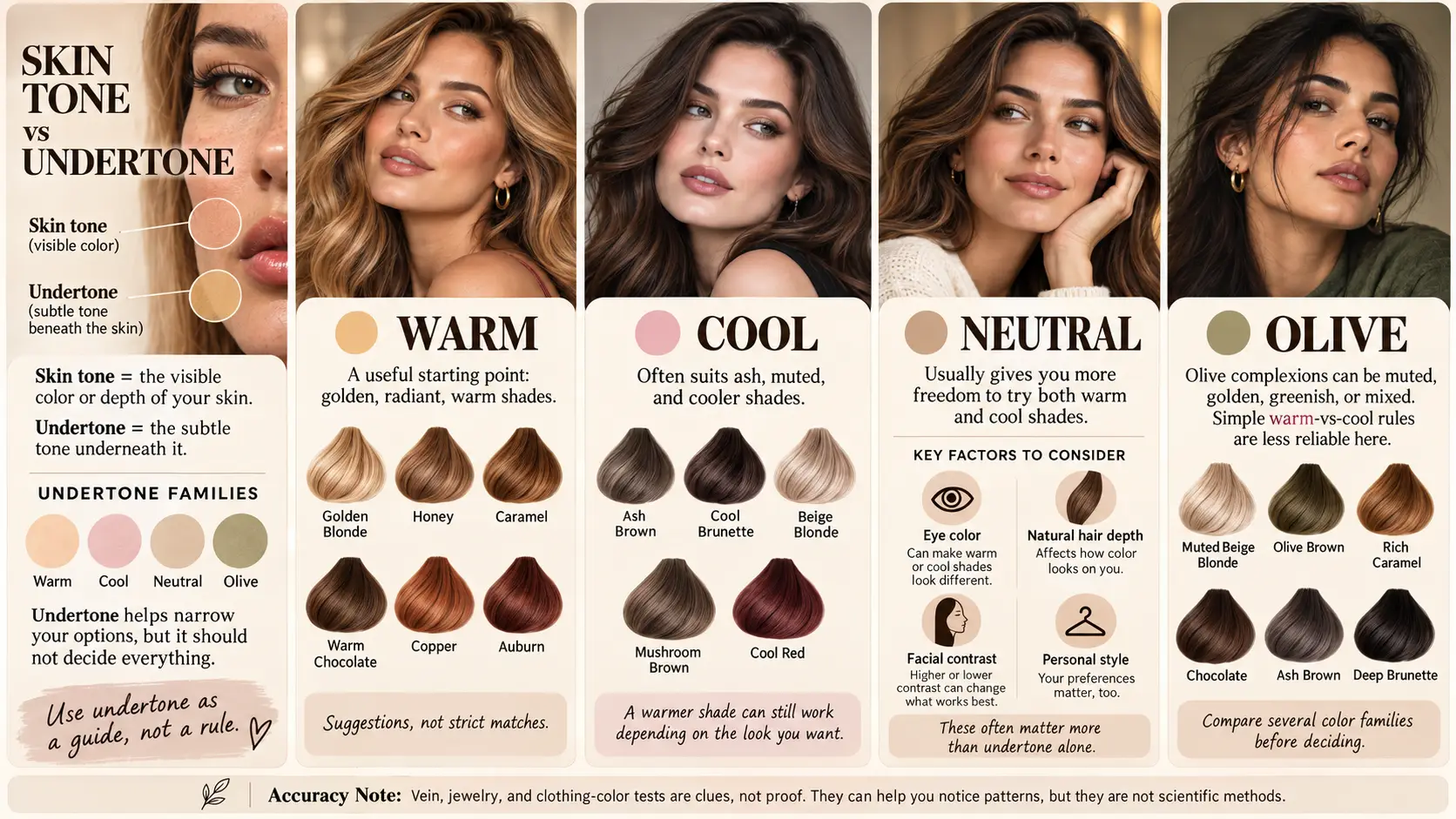
Start by explaining the difference in a simple way:
Skin tone is the visible color or depth of your skin. Undertone is the subtle warm, cool, neutral, or olive tone underneath it.
Explain that undertone can help narrow down hair color choices, but it should only be one part of the decision.
Warm Undertones
Explain that people with warm undertones can start by exploring shades with golden or warm characteristics, such as golden blonde, honey, caramel, warm chocolate, copper, and auburn. Make it clear that these colors are suggestions rather than strict matches.
The reader should understand that having a warm undertone does not mean every cool shade will look wrong. Use the idea that these are useful starting directions, not rules.
Cool Undertones
For cool undertones, introduce shades such as ash brown, cool brunette, beige blonde, mushroom brown, and cooler reds as useful options to explore.
Explain that these tones may work well with cooler coloring, but avoid suggesting that the reader must stay exclusively within this group. A warmer shade can still work depending on the person's contrast, eye color, natural hair, and the overall effect they want to create.
Neutral Undertones
Explain that neutral undertones often give people more freedom to experiment with both warm and cool hair colors. Instead of presenting a fixed list of ideal shades, show why other features become more useful for narrowing the choice.
Eye color, natural hair depth, facial contrast, and personal style can help determine whether a softer, warmer, cooler, lighter, or deeper shade creates the desired result.
Olive Undertones
Give olive undertones separate attention instead of automatically placing them in the warm or cool category. Explain that olive complexions can have muted, greenish, golden, or mixed characteristics, which makes simple warm versus cool rules less reliable.
Encourage the reader to consider several factors together and compare different color families rather than assuming one category will always work best.
Accuracy Note: If you mention the vein test, jewelry test, or clothing-color test, describe them only as clues . Do not present them as accurate or scientific methods for identifying undertone. The goal is to help the reader notice patterns, not give them a guaranteed diagnosis.
Your Facial Contrast Can Change the Answer Completely
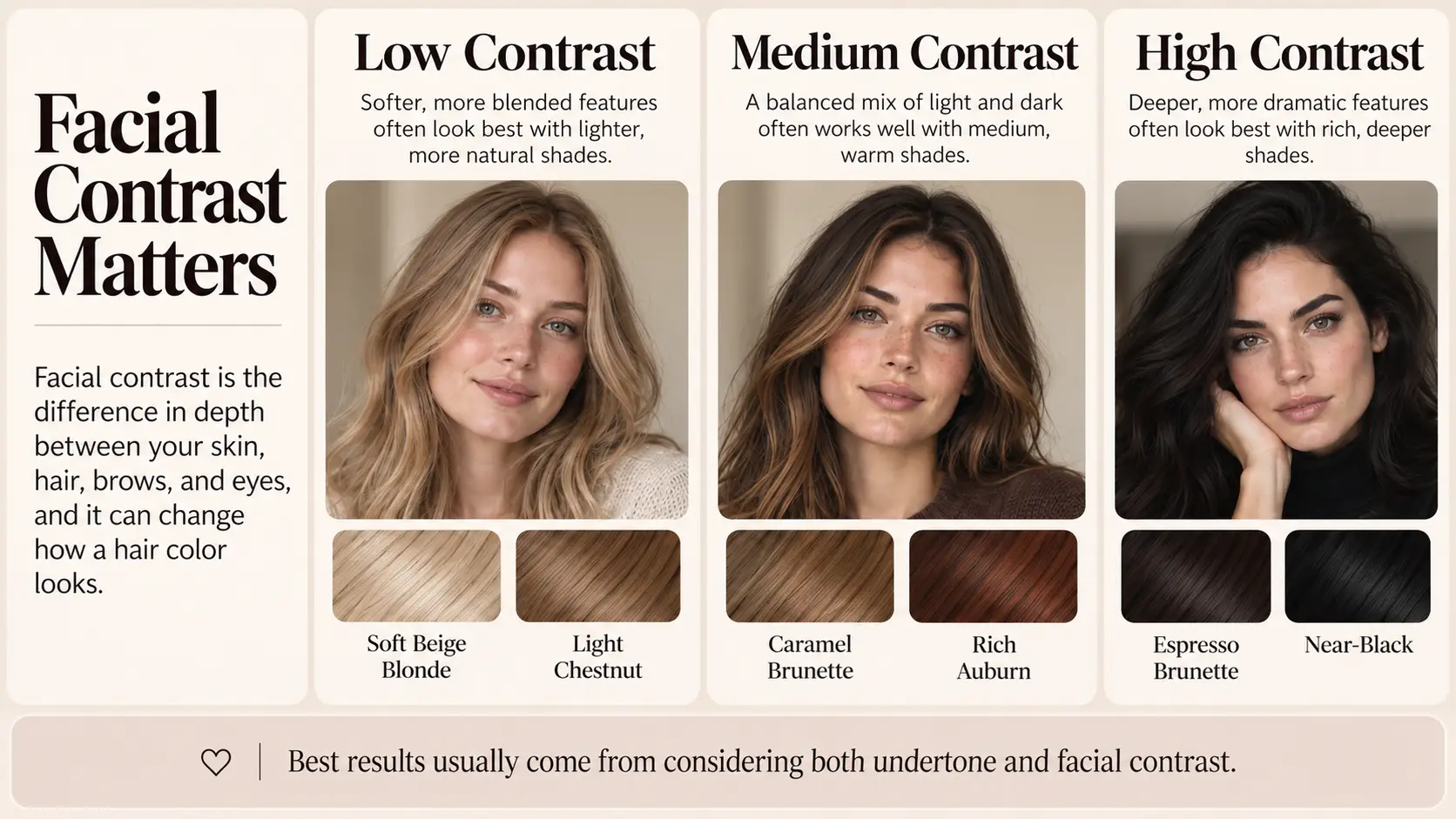
Your undertone is only part of the picture. Two people can have the same cool, warm, or neutral undertone and still look very different in the same hair color because their facial contrast is different.
Facial contrast describes how much visual difference there is between the depth of your natural hair, skin, eyebrows, and eyes. It is not about whether your complexion is light or dark. Instead, it is about how strongly those features stand apart from one another.
Low Contrast
A low-contrast face has relatively little difference between the depth of the skin, eyes, brows, and natural hair. The overall effect tends to look softer and more blended.
For someone with low contrast, moving to a hair color that is dramatically darker or much lighter than their natural coloring can create a strong visual shift. That does not mean the color will look bad—it simply means the result may feel more bold and transformational than seamless or understated.
If you want a softer change, shades that stay closer to the natural depth of your features often feel easier to integrate.
Medium Contrast
Medium contrast usually offers plenty of flexibility because there is already a noticeable—but not extreme—difference between the main facial features.
That can make it easier to experiment with both slightly lighter and deeper shades without one feature immediately overpowering the others. Brunettes may be able to move several levels lighter, while lighter-haired people may find richer shades surprisingly wearable.
The exact result will still depend on undertone, eye color, brow depth, and how dramatic you want the change to feel.
High Contrast
High contrast means there is a strong difference between your facial features. For example, someone may have lighter skin paired with naturally dark hair, deep brows, or strongly defined eyes.
On some high-contrast faces, deeper and more dramatic hair colors can feel visually balanced because the face already contains strong differences in value. Shades such as espresso brunette, dark chocolate, or a rich near-black may complement that existing definition rather than overwhelm it.
That does not make high contrast better than low contrast. It simply changes how strongly a particular hair color interacts with the rest of the face.
For example, two people may both have cool undertones, but the person with dark brows and high facial contrast may carry an espresso brunette very differently from someone with soft brows and low contrast.
This is why choosing hair color based on undertone alone can be misleading. The most convincing result usually comes from considering both color temperature and the natural contrast already present in your face.
Let Your Eye Color Refine the Shade, Not Choose It for You
Eye color can help fine-tune a hair color choice, but it should not be the starting point. A better approach is to first narrow down your options using undertone and facial contrast, then use your eyes to decide which version of that shade may look most balanced or striking.
There are two useful ways to do this:
Harmony: Echo Tones Already Present in Your Eyes
A harmonious hair color repeats or supports tones that are already visible in your eyes.
For example, golden or amber flecks in hazel eyes may look more noticeable next to caramel or warm brunette shades, while cool gray-blue eyes may pair naturally with ashier or more muted colors.
This creates a more blended, cohesive effect rather than making the eyes compete with the hair.
Contrast: Make the Eyes Stand Out More
The second approach is to choose a shade that creates noticeable contrast with the eyes.
Blue eyes, for example, can appear more vivid next to copper or warm brunette tones. Green eyes may look stronger beside auburn, copper, or a rich brunette because the warmer hair color creates visual separation from the eye color.
Neither strategy is automatically better. Harmony tends to feel softer and more connected, while contrast can create a stronger focal point.
Eye Color | Possible Direction |
|---|---|
Brown | Chocolate, caramel, warm brunette, or a dramatic cooler contrast |
Blue | Beige or blonde harmony, or copper and warmer contrast |
Green | Copper, auburn, or rich brunette |
Hazel | Choose shades that emphasize the gold, green, or brown flecks you want to bring forward |
Gray | Ash-toned harmony or warmer shades for contrast |
The important point is that eye color is a modifier, not the primary selector.
If you are wondering what hair color looks best on me, eye color should usually come after undertone and facial contrast—not before them. The goal is to refine a shortlist you already have, rather than build a completely separate list of shades based only on whether your eyes are blue, brown, green, or hazel.
That is also why generic “best colors for blue eyes” or “best shades for green eyes” lists can be misleading. Two people with the same eye color may need completely different hair colors because their undertone, brow depth, natural hair depth, and facial contrast are different.
Once you have narrowed your options, you can also see myself with different hair color previews to compare whether you prefer a harmonious effect or a stronger eye-enhancing contrast before committing to the change.
Before Choosing the Shade, Look at the Hair You Have Now
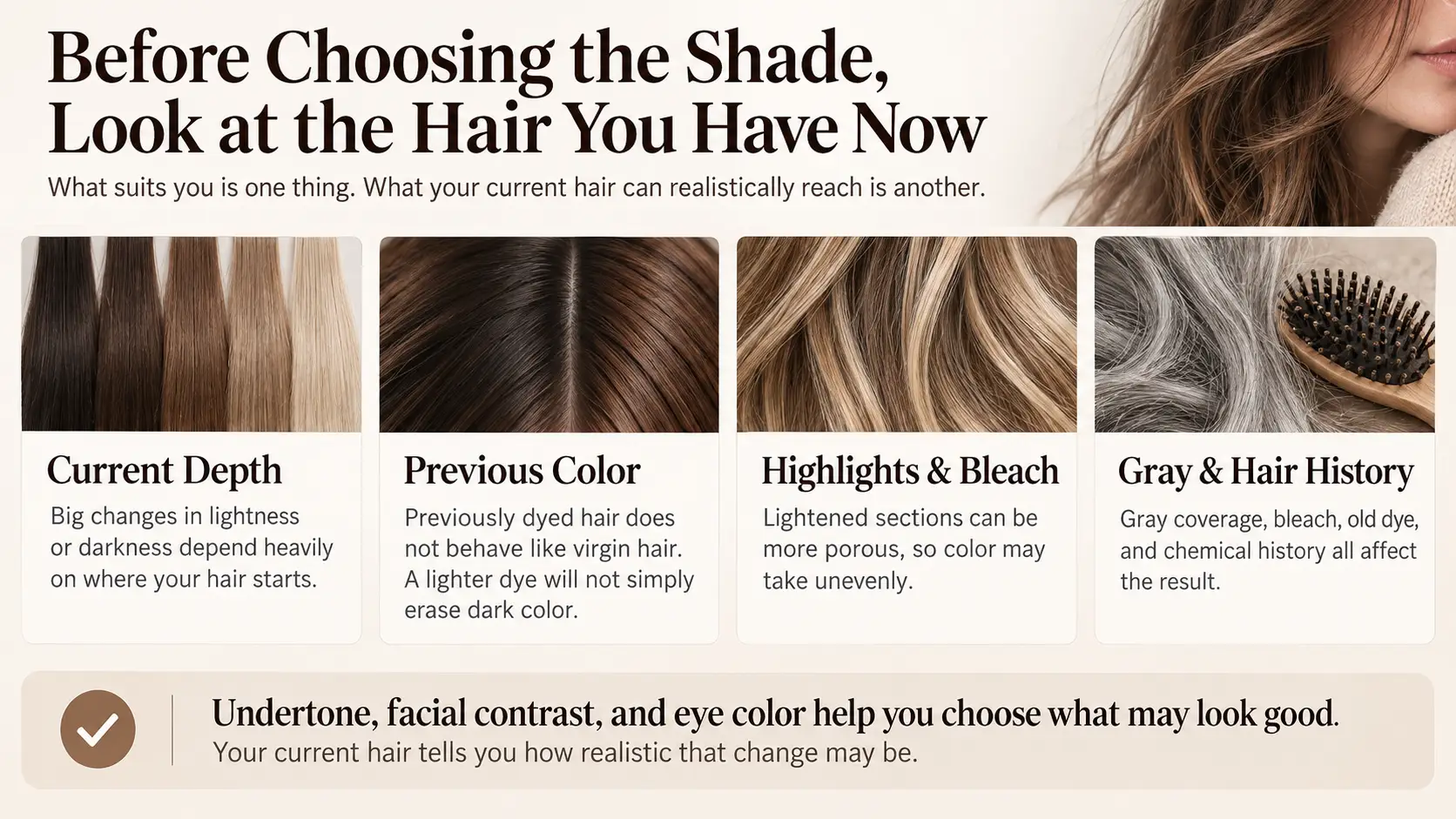
The color that flatters your face is not always the color you can reach easily.
Before deciding what hair color should I dye my hair, look at your current hair first: its natural depth, previous color, highlights, gray coverage needs, visible warmth, and overall chemical history can all affect the final result.
Start With Your Current Depth
Think about how far your target shade is from where your hair is now. Going from virgin light brown to dark brunette is mainly about adding depth. Going from naturally dark brunette to light blonde is a much bigger shift because the hair may need substantial lightening before the target color can be reached. In general, the larger the change in depth, the more your starting point matters.
Previously Colored Hair Plays by Different Rules
Natural hair and previously dyed hair should not be treated as the same canvas. If dark artificial pigment is already present, applying a lighter permanent color over it does not simply make that old color disappear.
Revlon’s consumer hair-color guidance specifically warns that previously dyed dark hair cannot simply be lightened by putting a lighter permanent shade over it.
That is why naturally dark hair going blonde and previously dyed dark hair going blonde can require very different approaches.
Highlights and Bleach Can Change How Color Takes
Highlighted or bleached sections may be more porous than untouched hair. That can affect how quickly they absorb color and how evenly a darker shade appears.
Hair with natural roots, old highlights, and previously colored lengths may therefore react differently across different sections. The starting canvas is rarely completely uniform.
Gray Coverage Needs Its Own Consideration
If your goal includes covering gray hair, shade choice is only part of the decision. The amount of gray and the type of coverage you want can influence which product or formulation makes sense. Blending a few gray strands is different from trying to achieve consistent full coverage.
Pay Attention to Warmth Already in the Hair
Hair may already contain red, orange, gold, or copper pigments—naturally or from earlier coloring and lightening.
Those underlying tones can influence how a new shade develops. A cool brunette shade, for example, may not look the same on a warm starting base as it does on a more neutral one.
This is one reason the shade shown on a box, swatch, or digital preview should be treated as a direction rather than an exact promise.
Your Hair History Matters More Than the Last Color
Think beyond what you did most recently. Previous permanent color, bleach, highlights, color removers, and other chemical treatments can all affect the condition and behavior of the hair.
You do not need professional colorist formulas to understand this. You only need to know whether your hair is starting from a relatively simple base or a more complicated color history.
Starting Point | Desired Change | What You Should Know |
|---|---|---|
Virgin light brown | Dark brunette | Mostly adding depth |
Virgin dark brunette | Light blonde | Significant lightening may be needed |
Previously dyed dark | Blonde | More complex than applying a lighter dye |
Highlighted hair | Darker shade | Porosity can affect how evenly color deposits |
Gray hair | Full coverage | Product and formulation choice matter |
The key distinction is this:
Undertone, facial contrast, and eye color help you decide what may look good. Your current hair tells you how realistic and straightforward that change may be.
Use both before settling on the final shade.
Which Hair Color Family Should You Try First?
Once you have considered your undertone, facial contrast, eye color, and current hair, the next step is not choosing one exact shade. It is choosing the right color family to test first.
If you are still wondering what hair color looks best on me, this matrix gives you a practical place to start.
If You Want… | Start Testing… |
|---|---|
A subtle, natural change | Chocolate, beige brunette, soft caramel |
More warmth around the face | Honey, caramel, copper, warm chestnut |
A cooler, polished look | Ash brown, mushroom brunette, beige or ash blonde |
Stronger contrast | Espresso, deep brunette, platinum where realistic |
A softer appearance | Dimensional brunette, bronde, balayage |
A statement look | Copper, vivid red, platinum, or fantasy shades |
Blonde
Blonde can make the overall look feel lighter, brighter, and more open, but the effect changes dramatically depending on how light you go. Beige and darker blondes tend to feel softer and easier to blend, while platinum creates a much sharper transformation. You also do not need to become “fully blonde” to get the effect—bronde, highlights, or face-framing pieces can introduce brightness without changing the entire base.
Brunette
Brunette is one of the most flexible families because it can move from soft beige brown all the way to rich chocolate and deep espresso. Lighter brunettes can create a relaxed, natural effect, while deeper shades add definition and visual weight around the face. Dimensional brunette—using subtle differences in depth rather than one flat color—can also make the result feel softer and more natural.
Black / Very Dark
Very dark hair creates definition quickly. It can sharpen the visual contrast between the hair and facial features, make brows and eyes appear more prominent, and give the overall look a stronger frame. Because the change can be dramatic, especially from a lighter starting point, it is worth previewing several depths rather than jumping immediately to pure black. Deep espresso or soft black can create a similar effect with slightly less intensity.
Copper & Red
Copper and red shades bring noticeable warmth and personality to the face. Soft strawberry, muted copper, auburn, and vivid red can all produce very different effects even though they belong to the same broad family. Copper often creates a bright, energetic result, while auburn and deeper reds can feel richer and more grounded. This is a useful family to explore when you want your hair color itself to become a stronger part of the overall look.
Fantasy Colors
Fantasy shades—such as pink, blue, lavender, green, or highly saturated combinations—work differently from natural color families because the goal is often expression rather than seamless realism. Think about whether you want the color to dominate the look or simply appear as an accent. Pastels tend to create a softer effect, while deep or highly saturated shades feel more graphic and intentional. Your current hair depth can also strongly affect how achievable the preview is in real life.
You do not need to choose your final shade immediately. Start with the family that matches the effect you want, then compare several nearby shades within it.
If you want to see myself with different hair color options before committing, testing a few variations within the same family is usually more useful than comparing completely unrelated colors at random.
See It Before You Dye: What AI Hair Color Try-On Can Actually Show You
A hair color can sound perfect on paper and still feel completely different once you see it around your own face. That is where virtual try-on becomes useful.
Modern hair-color preview systems generally need to identify the hair area in an image and change its visual appearance while keeping the face and surrounding photo as consistent as possible. Hair segmentation has long been an important challenge in virtual hair recoloring because the system has to deal with fine strands, irregular edges, lighting, and complex backgrounds.
Newer hair-editing research goes further by trying to control hair color separately from hairstyle while preserving other characteristics such as facial identity and the surrounding image.
You do not need to understand any of that technology to use it effectively. The useful question is simply: what can the preview actually help you decide?
What AI Can Help You Judge
A virtual preview can make comparisons that are difficult to imagine from a swatch alone.
You can use an AI hairstyle changer to compare whether:
darker or lighter hair feels more balanced around your face;
warmer or cooler-looking shades create the effect you prefer;
a bold color complements your features or dominates them;
you prefer brunette, blonde, copper, red, or another shade family on yourself;
the finished look actually fits your personal style.
Betatum's AI Hairstyle tool, for example, lets you change the hairstyle, hair color, or both on your own photo so different options can be compared before making the real change.
This is especially useful once you have already narrowed your options. Instead of testing ten unrelated shades, compare two or three realistic candidates and look at the entire face—not just the hair.
What AI Cannot Promise
A convincing preview is still a visual simulation. It cannot tell you exactly what will happen when real hair and real color chemistry are involved.
It cannot reliably promise:
the exact shade your dye will produce;
how much lightening or bleaching may be required;
how previously damaged or chemically treated hair will react;
exactly how the color will fade after washing and time;
an identical result from a salon or at-home color application.
Your starting color, previous dye, porosity, underlying pigment, product choice, and application process can all affect the real result in ways a photo preview cannot fully reproduce.
Treat the preview as a visual decision tool, not a chemical prediction.
Its biggest value is helping you answer, “Do I actually like this direction on me?” before you make a harder-to-reverse change.
Don’t Test One “Perfect” Color—Test Three Versions
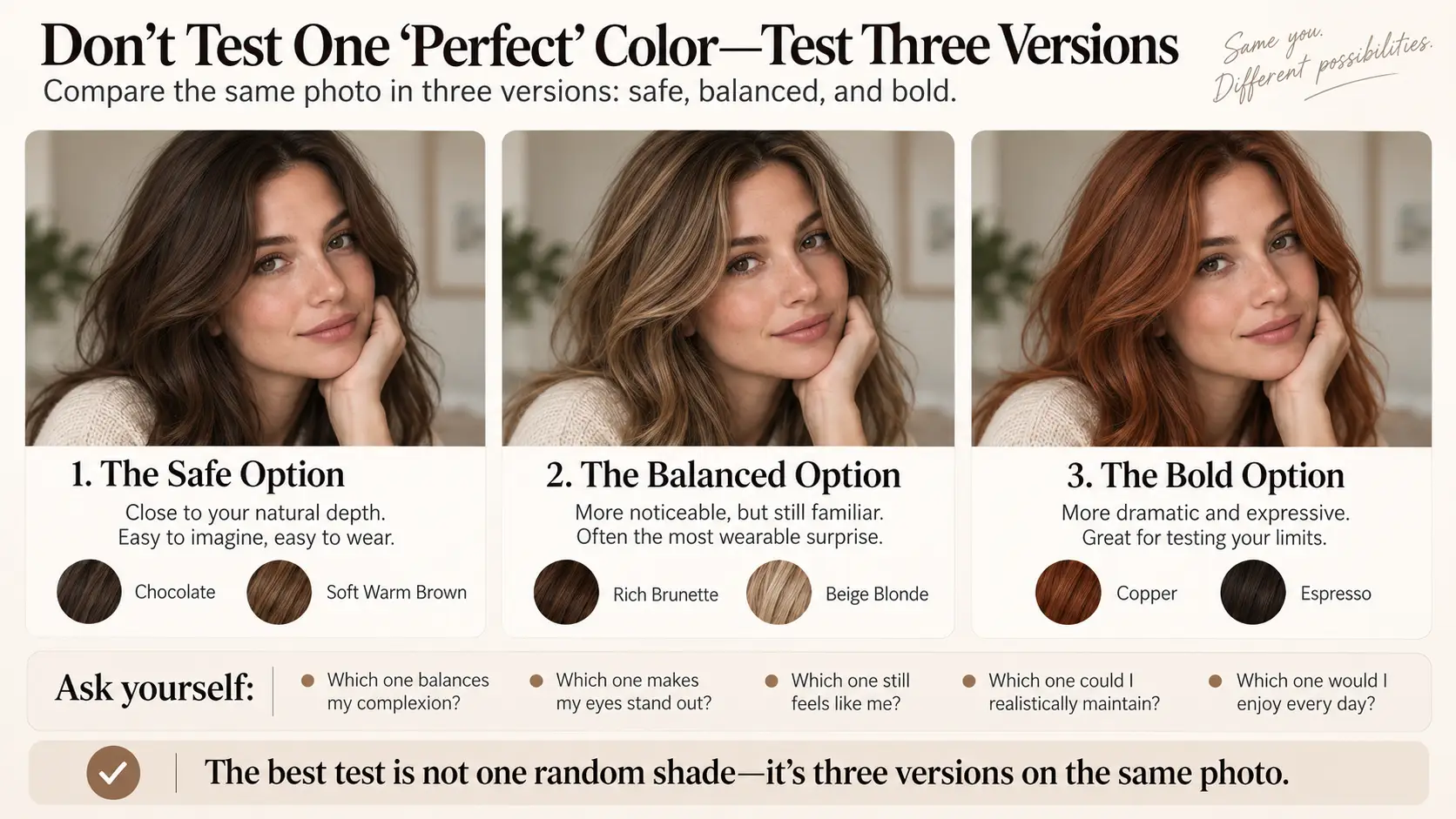
Trying to find one perfect shade can make the decision harder than it needs to be.
Instead, give yourself three versions to compare. Think of it as a quick fitting-room test for your hair.
1. The Safe Option
Choose a shade that stays fairly close to your current or natural depth. Maybe that means moving from medium brown to chocolate, adding a little warmth, or going slightly lighter without changing your overall contrast very much. This is your “Could I easily imagine myself like this?” option.
2. The Balanced Option
Now make the change more noticeable, but not extreme. Try a shade that shifts the overall look while still working with your existing contrast—perhaps a richer brunette, softer blonde, warmer copper-brown, or cooler beige tone.
This is often the option that surprises people most: different enough to feel fresh, but still familiar.
3. The Bold Option
Now give yourself permission to go further. Try something much lighter, deeper, warmer, cooler, or more vivid than you would normally choose. Think platinum instead of beige blonde, espresso instead of medium brown, or copper instead of subtle caramel.
You may love it. You may immediately rule it out. Both outcomes are useful. The important part is to compare all three versions using the same photo. Changing the angle, lighting, makeup, or expression can make it much harder to tell whether you actually prefer the hair color.
Then ask yourself:
Which one makes my overall complexion look the most balanced?
Which one makes my eyes stand out?
Which one still feels like “me”?
Which one would I realistically maintain?
Which one would I be comfortable seeing every day—not just in one great photo?
If you want to see myself with different hair color options, this three-version test is much more useful than endlessly cycling through random shades.
And do not feel pressured to choose the boldest transformation just because it looks dramatic on screen. Sometimes the best option is the one that makes you look at the whole face first—and notice the hair second.
A Beautiful Color Can Still Be the Wrong Choice If You Hate the Maintenance
A hair color can look incredible in a preview and still be the wrong choice for your everyday life.
Before committing, think about what happens after the first great result. How noticeable will your roots be? Will you be comfortable refreshing the tone at home? Are you happy to return to a salon regularly, or would you rather choose something that grows out more quietly?
Think About the Root Contrast
The bigger the difference between your natural hair and your new color, the more noticeable new growth may become.
A brunette staying close to their natural depth may see a relatively subtle transition at the roots. Someone moving from naturally dark hair to a very light blonde is likely to notice that contrast much sooner.
Gray coverage creates another consideration: if complete coverage is important to you, visible regrowth may affect how often you feel the color needs attention.
Some Shades Change More Noticeably as They Fade
Fresh color does not always stay visually identical over time.
Cooler blondes and brunettes may gradually lose some of their coolness, while copper, vivid red, and fantasy shades can become softer or shift in appearance as the color fades.
That does not make these shades poor choices. It simply means you should like the maintenance process almost as much as you like the fresh result.
Toning products or color-depositing care may help maintain the direction of some shades between full color services, depending on the formula and your hair.
Lightening Can Turn One Color Change Into an Ongoing Commitment
Going significantly lighter can involve more than the first appointment.
Previously lightened sections may need continued care, and maintaining a very light result can involve repeated lightening as natural hair grows in. The greater the transformation, the more important it becomes to consider salon time, hair condition, and your willingness to maintain the result.
Your at-home routine may change too. Color-safe shampoo, conditioning treatments, toning products, or other maintenance products can become part of keeping the color looking the way you intended.
Change | Typical Maintenance Commitment |
|---|---|
Similar brunette depth | Lower |
Subtle balayage | Low–moderate |
Significant blonde transformation | Higher |
Platinum / very light blonde | High |
Copper / vivid red | Moderate–high |
Fantasy shades | High |
These are useful general comparisons, not fixed rules. Actual upkeep varies by starting color, technique, growth, and formula.
So before choosing between two shades that both look good, ask one more question:
Which one fits the amount of time, money, and attention I actually want to give my hair? Sometimes the slightly less dramatic option becomes the better color simply because you will enjoy living with it longer.
Before You Dye, Do This Final Reality Check
You have found a color you like. Now make sure it also makes sense for your real hair. Before you dye, run through these five checks.
1. Save Your Favorite Preview
Keep the AI preview you like most and look at it again under neutral lighting.
Do not judge only the hair. Look at the whole face.
Ask yourself:
Does the color still feel balanced?
Does it suit your overall look?
Would you be happy seeing this color every day?
2. Compare It With Your Current Hair
Now look at how different the preview is from your hair today.
A small change from medium brown to chocolate is usually a very different situation from going dark brunette to platinum blonde.
The bigger the difference, the more likely the process may involve extra steps.
3. Think About Your Hair History
Previous permanent dye, bleach, highlights, or color removal can affect what is realistically possible.
If your hair has already been chemically treated, do not assume the preview can be recreated in one simple step.
For a major transformation, especially a big lightening change, it is worth showing the reference image to a professional colorist and asking what is realistic for your current hair.
4. Follow the Dye Instructions
If you are coloring your hair at home, follow the manufacturer’s instructions for that specific product.
Do not try to copy the AI result by guessing your own formula.
An AI preview can show you the look you want. It cannot tell you exactly how to chemically produce that result on your hair.
5. Do the Allergy Test Every Time
Do not skip the required skin allergy test.
The FDA advises consumers to test hair dye on the skin before use and to repeat the test every time they dye their hair. Its consumer guidance uses a 48-hour test period.
“Do a patch test before using dye on your hair.” — FDA
This is not about making hair color feel risky or complicated. It is simply a smart final check.
The goal is simple: make sure the color you love on screen is also realistic, maintainable, and appropriate for the hair you actually have.
What If Two Hair Colors Both Look Good on You?
Sometimes there is no single obvious winner.
Two shades can both suit your features, work with your contrast, and look convincing in a preview—yet create completely different versions of you.
When that happens, stop asking which color is “more flattering” and ask a better question:
What do I want the color to change about my overall look?
Use the effect you want as the tiebreaker.
You Want To Look… | Choose the Option That… |
|---|---|
Softer | Reduces strong facial contrast |
Brighter | Adds dimension or lightness around the face |
More dramatic | Increases contrast |
Warmer | Introduces golden, caramel, or copper tones |
Cooler / more polished | Moves toward beige, ash, or more muted tones |
More natural | Stays closer to your existing depth |
For example, imagine both a soft chocolate brunette and a deeper espresso look good on you.
The chocolate may create a softer, more blended effect. The espresso may give your features more definition and make the overall look feel stronger.
Neither is automatically better. They are simply doing different jobs.
The same can happen with blonde shades. A dimensional beige blonde may brighten the face without completely changing your contrast, while a much lighter blonde can create a more noticeable transformation.
This is also where personal style matters more than any color chart.
Do you want your new hair to quietly fit into your existing look, or do you want people to notice the change immediately? Do you prefer soft and effortless, or sharp and polished?
Once two shades have already passed the “Does this suit me?” test, your desired effect can make the final decision much easier.
The best hair color is not necessarily the one a chart ranks first. It is the one that fits your features, your hair and the version of yourself you actually want to see.
So, What Hair Color Suits You Best?
The best answer is usually not one magic shade name.
It is the shade that makes sense when you combine what flatters your features with what works for your real hair and your real life.
A simple way to think about it is this:
Your best starting shade = undertone direction + flattering contrast + realistic hair condition + acceptable maintenance + personal preference
That is why the answer is rarely just best hair color for skin tone or only hair color for skin undertone. Those things matter, but they are only part of the decision.
Instead of scrolling through dozens of random shades, test 2–3 genuinely different options:
one that feels safe and close to your current look,
one that feels balanced and wearable,
and one that feels bolder than what you would normally choose.
That small comparison is usually far more useful than trying twenty nearly identical colors.
If you want to make the decision easier, use an AI Hairstyle preview to compare those shades on your own photo before you commit.
See the difference on your own face before you commit to the dye.
Use the preview as a visual decision tool—not as a promise of the exact chemical or salon result. Its real value is helping you decide which direction feels most like you.