
Virtual Staging vs Physical Staging: Which Sells Homes Better?
By Parisa · 2026-09-13
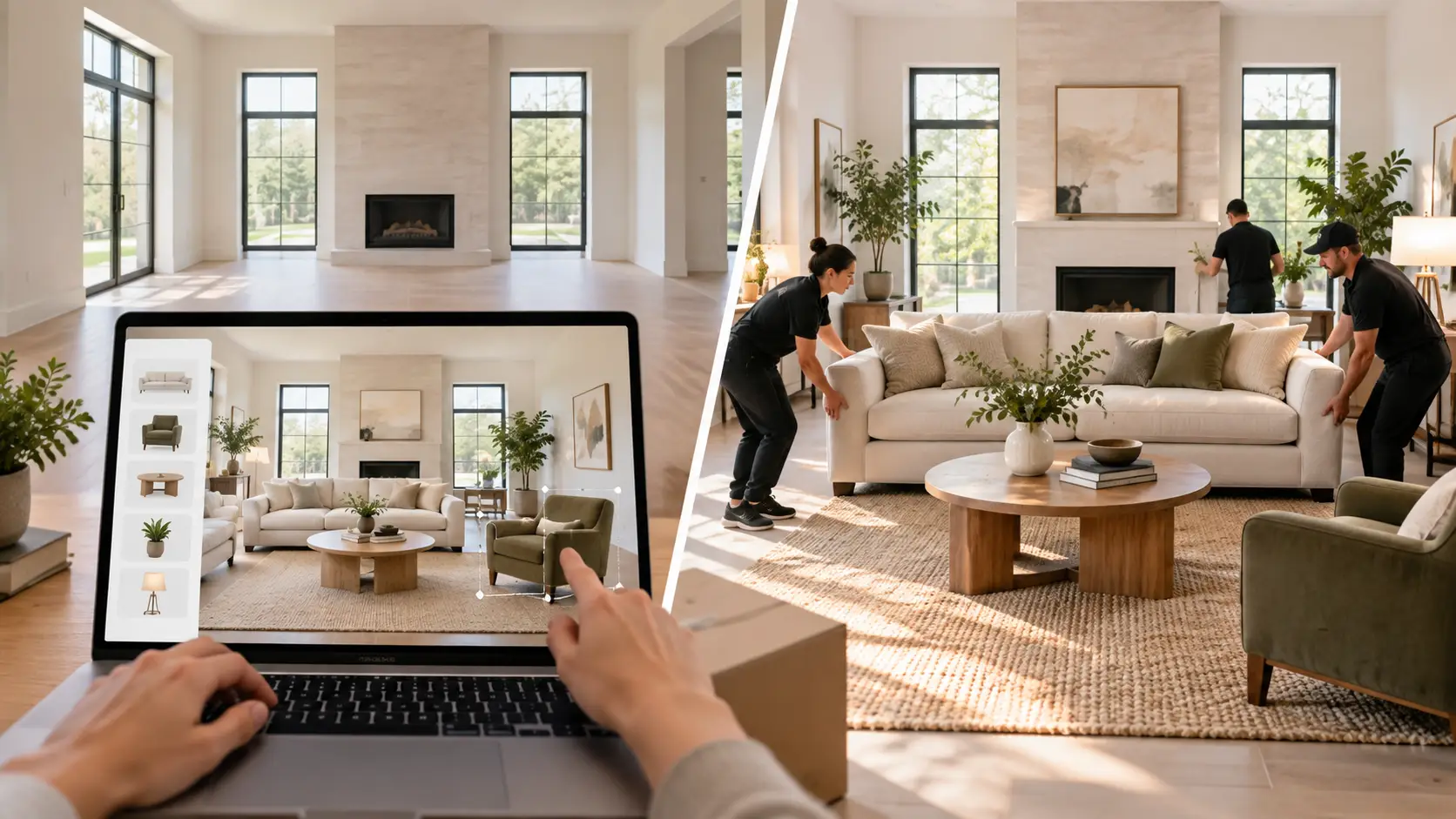
Compare virtual vs physical staging by cost, speed, buyer impact, and use case to see which approach can help your home sell more effectively.
Virtual staging and physical staging solve the same problem in different ways: they help buyers understand an empty or unfinished space. Virtual staging does that through the listing photos. Physical staging goes one step further because buyers can experience the furnished space when they visit the property.
So which one sells homes better? There is no proven universal winner. The better choice depends on where the property needs the most help:
Listing → Showing → Offer
Quick Summary
Virtual and physical staging both help buyers understand a home, but they work at different stages of the buying journey.
Virtual staging: best for listing photos, speed, and flexibility.
Physical staging: best for in-person showings and real spatial experience.
Neither is always better: the right choice depends on the property.
Hybrid staging: can combine the strengths of both methods.
Virtual Staging vs Physical Staging: What Actually Changes?
Virtual staging adds furniture and decor digitally to property photos. The room itself stays empty. Physical staging uses real furniture, lighting, artwork, and decor inside the home.
Buyer Experience | Virtual Staging | Physical Staging |
|---|---|---|
Visible in listing photos | Yes | Yes |
Helps explain room use | Yes | Yes |
Changes the real room | No | Yes |
Continues into the showing | No | Yes |
Easy to restyle | Yes | Less flexible |
Requires furniture logistics | No | Yes |
Online, both methods can make an empty room easier to understand. The difference becomes much clearer once the buyer walks through the door.
Which Sells Better?
Research supports staging in general, but it does not prove that virtual staging consistently sells homes better than physical staging or vice versa.
The 2025 National Association of REALTORS® Profile of Home Staging found that:
83% of buyers' agents said staging helped buyers visualize a property as their future home.
29% reported an increase of 1%–10% in the dollar value offered.
49% of sellers' agents reported some decrease in time on market.
Those numbers matter, but they should not be stretched too far.
They show that staging can influence how buyers see a property. They do not tell us that one staging method always performs better than the other.
When Virtual Staging Works Best
Virtual staging is most useful when the main problem is the listing photo. An empty bedroom might tell buyers the room is 11 × 12 feet. A staged image can make that more meaningful by showing how a bed, nightstands, and walking space could fit together.
It can work especially well for:
vacant properties;
listings that need to go live quickly;
rooms with an unclear purpose;
multiple empty rooms;
listings where several design styles need to be tested.
Photos already play a major role in online home search. NAR's 2025 research found that 83% of internet-using buyers considered property photos very useful. That makes better visualization worthwhile.
But virtual staging should help buyers understand the room, not make the room look larger or more functional than it really is. The furniture should explain the space, not exaggerate it.
Where Physical Staging Has the Advantage
Physical staging keeps working after the buyer arrives.
A staged living room lets buyers see how much space a sofa really takes up. A dining table gives them a better sense of circulation. Furniture can also make an awkward or oversized room easier to understand. That is something virtual staging cannot fully reproduce.
Physical staging can be particularly useful for:
open houses;
unusual floor plans;
very large or very small rooms;
homes that feel cold or unfinished when empty;
properties where the in-person experience is part of the selling strategy.
The simplest distinction is this: Virtual staging helps buyers imagine the space. Physical staging lets them experience it.
How Do the Costs Compare?
The two methods have completely different cost structures, so comparing one generic price is not very useful. Physical staging may include:
Consultation + Furniture Rental + Delivery + Setup + Rental Period + Removal
According to the 2025 NAR survey, the median cost was:
$1,500 when a professional staging service was used;
$500 when the seller's agent handled the staging.
These are survey medians, not fixed market prices.
Virtual staging is usually calculated differently:
Number of Images + Generation Cost or Credits + Revisions
That means the real question is not simply which method is cheaper.
It is whether the cost makes sense for the problem the seller is trying to solve.
Which One Gets the Listing Ready Faster?
Virtual staging removes most of the physical coordination involved in furnishing a home. Physical staging can require furniture availability, delivery, setup, photography, and eventually removal.
Virtual staging usually starts after the property has already been photographed. That can make a difference when timing is tight. A vacant investment property that needs to be listed this week may be a strong candidate for virtual staging.
A property being prepared several weeks before launch may have enough time for physical staging. Speed matters most when staging could delay the listing.
Do Virtually Staged Photos Need Disclosure?
Disclosure rules vary by location, MLS, and platform, so agents should check the requirements that apply to each listing. California is one example.
AB 723 took effect on January 1, 2026, and CRMLS guidance addresses digitally altered real-estate photos, including changes involving furniture.
A simple workflow is:
Keep Original → Create Staged Version → Label or Disclose → Publish
Keeping the original image is useful even when it is not specifically required.
It gives buyers a clear reference for what the property actually looks like without digital furniture.
When Should You Choose Virtual Staging?
Virtual staging is often the better fit when:
the property is vacant;
the main problem is weak listing photos;
the launch deadline is tight;
several design directions need to be tested;
physically staging every room would be unnecessary;
buyers mainly need help understanding scale or room purpose.
In these cases, the goal is simple: make the empty space easier to understand online.
How to Virtually Stage a Room With AI
Once virtual staging makes sense for a property, the next step is to create a staged image without changing the facts of the room.
A simple AI virtual staging workflow looks like this:
1. Start With a Clear Photo of the Empty Room
Use a well-lit image that clearly shows the walls, windows, doors, flooring, and other permanent features. A clean source photo gives the AI a better foundation to work with.
2. Choose the Room Type and Style
Select the type of room you are staging, such as a living room, bedroom, dining room, or home office. Then choose a design direction that fits the property and likely buyer.
3. Generate the Furnished Version
Use an AI virtual staging tool such as Betatum AI Virtual Staging to add furniture and decor to the image.
The goal is not to redesign the property. It is to help buyers understand how the existing space could realistically be used.
4. Review the Image Before Publishing
Before using the image in a listing, make sure the furniture looks realistic and the staged version does not alter the room’s permanent features or make the space appear larger than it really is. We’ll cover the full pre-publishing checklist later in this guide.
5. Use the Staged Image to Clarify the Space
Once the image looks realistic, use it to help buyers understand how the room could be furnished and used. The staged version should add context—not hide flaws, change permanent features, or create a version of the property that buyers could not realistically experience in person.
Used this way, AI virtual staging becomes a visualization aid rather than a redesign of the property
When Is Physical Staging Worth It?
Physical staging makes more sense when the showing itself needs help.
That may include properties where:
open houses are important;
empty rooms feel awkward in person;
the layout is difficult to understand;
furniture scale matters;
the seller wants buyers to experience a fully furnished home.
A higher property price alone is not enough reason to choose physical staging. The decision should come back to how buyers interact with the space.
Sometimes Using Both Makes More Sense
Staging does not have to be all or nothing. A seller could physically stage the rooms that matter most during a showing, such as the living room and primary bedroom.
Secondary rooms could then be virtually staged for the listing photos.
For example:
Physical staging:
Living room + Primary bedroom
Virtual staging:
Home office + Spare bedroom + Secondary living area
This puts the physical-staging budget where buyers can actually experience it while still making the full listing gallery easier to understand.
6 Things to Check Before Publishing Virtual Staging
Before publishing a virtually staged image, check:
Furniture scale — Does everything realistically fit?
Architecture — Are windows, doors, walls, and permanent features unchanged?
Walking space — Would the layout work in the real room?
Lighting — Do shadows and light feel consistent?
Original image — Has the unedited photo been saved?
Disclosure — Have the relevant MLS and platform rules been checked?
Virtual staging should improve presentation without changing the facts of the property.
So, Which One Actually Sells Homes Better?
There is no proven universal winner. Virtual staging is usually stronger when the main challenge is how the home looks online. Physical staging becomes more valuable when the in-person showing also needs to sell the space. And sometimes the best strategy is to use both.
Use virtual staging to improve what buyers see before the visit. Use physical staging to improve what they experience after they arrive.