
Future of AI-Powered Image Editing
By Maria · 2026-06-27
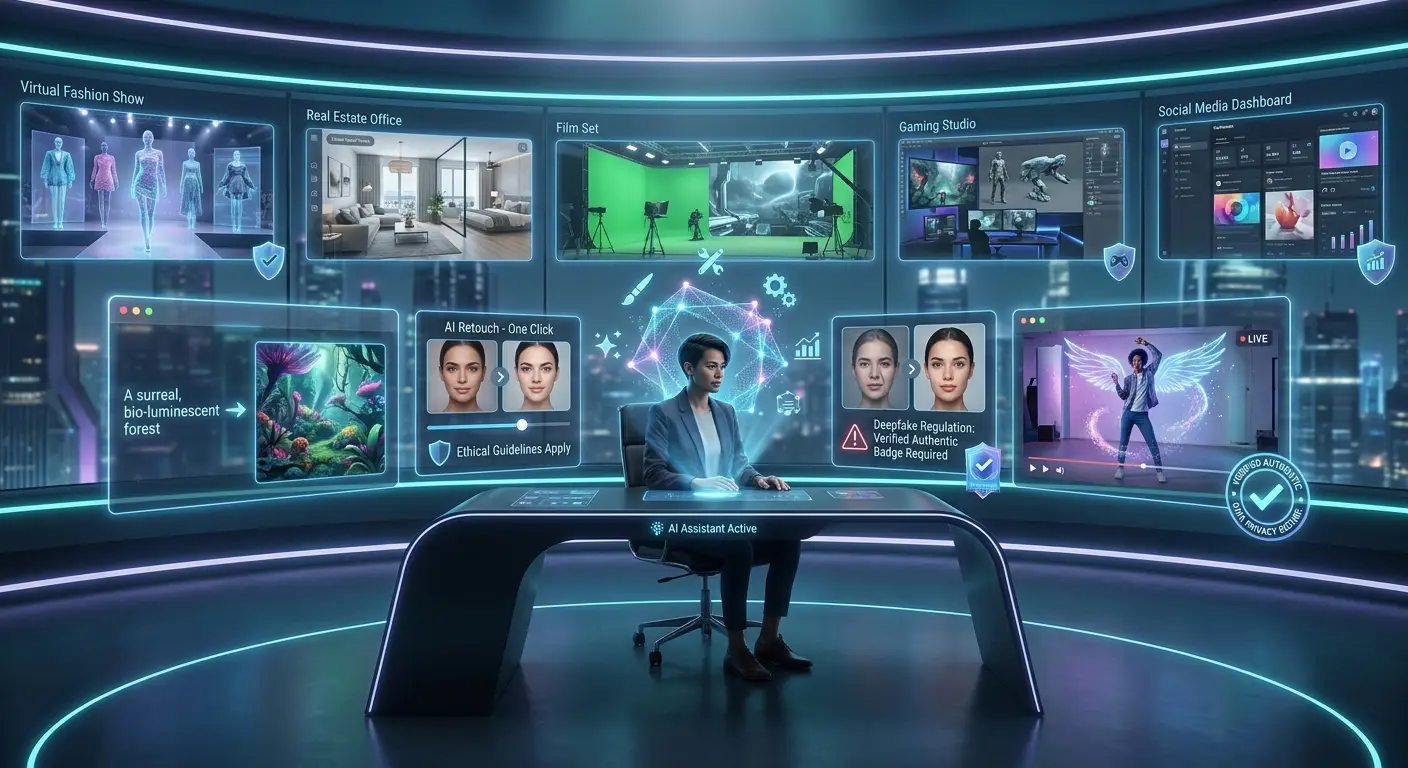
Discover how AI-powered image editing is transforming digital creativity through generative AI, intelligent automation, and next-generation editing tools. This article explores emerging trends, market growth, future technologies, industry applications, ethical challenges, and expert predictions to help creators and businesses prepare for the future of visual content.
AI-powered image editing is quickly becoming a global trend as businesses, creators, photographers, and everyday users look for faster and smarter ways to create visual content. Artificial intelligence is transforming photography and design by making advanced editing techniques more accessible, from automatic enhancements and AI retouching software to generative AI photography and text-to-image AI tools that can create entirely new visuals from simple ideas. As these technologies continue to evolve, the future of image editing is moving beyond traditional adjustments toward intelligent systems that understand creativity, style, and user preferences.
In this article, readers will discover how AI is reshaping the creative industry, the opportunities and challenges behind technologies like AI face swap and synthetic photography, and what the next generation of AI-powered editing tools may look like.
Summery
AI is reshaping the way visual content is created and edited by introducing tools that can understand, generate, and transform images with remarkable speed and accuracy. What once required advanced technical skills can now be done through intelligent systems powered by machine learning and generative models, allowing users to produce high-quality visuals with simple inputs. As these technologies continue to advance, image editing is becoming less about manual adjustments and more about creative direction, where AI handles the complexity and humans focus on ideas and storytelling.
How AI-Powered Image Editing Evolved So Quickly
AI-powered image editing has evolved from simple digital filters into advanced creative systems that can understand, analyze, and transform images with remarkable accuracy. In the past, photo editing mainly involved manual adjustments like cropping, color correction, and applying basic effects, but today AI-powered image editing tools can automatically enhance photos, remove objects, restore old images, and create realistic changes with minimal user input. The rise of generative AI photography and text-to-image AI has pushed this transformation even further by allowing users to generate original visuals, redesign scenes, and explore new creative ideas using simple text prompts.
Major breakthroughs in machine learning, computer vision, AI retouching software, and image generation models have changed image editing forever, making professional-level creativity more accessible while also introducing new conversations around synthetic photography, authenticity, and deepfake concerns.
AI Image Editing Market Overview & Statistics
The AI image editing industry has experienced rapid expansion between 2020 and 2025, driven by the widespread adoption of generative AI photography, automation in design workflows, and the growing demand for AI retouching software across social media, e-commerce, and creative industries. Below is a snapshot of key market indicators that highlight this transformation.
AI Image Editing Market: Key Numbers You Need to Know
Metric | 2020 | 2025 (Estimated) | Growth Insight |
|---|---|---|---|
Global Market Size | ~$2–3 billion | ~$10–15+ billion | Strong expansion driven by generative AI tools |
CAGR (2020–2025) | — | ~25%–35% | Rapid acceleration due to AI adoption in creative industries |
Active Users of AI Image Editing Tools | ~100–150 million users | ~500–800+ million users | Massive growth fueled by mobile apps and cloud platforms |
AI-Generated Images per Day | <10 million | 100+ million | Explosion of synthetic photography and text-to-image AI use |
Enterprise Adoption Rate | ~15% of companies | 60%+ of companies | AI integrated into marketing, design, and e-commerce workflows |
Comparison of AI Image Editing Adoption (2020 vs 2025)
Between 2020 and 2025, AI image editing has shifted from being a niche tool used by early adopters to a mainstream creative solution. In 2020, most editing workflows were still manual, with limited AI assistance such as basic auto-enhancement and filter suggestions. By 2025, however, AI-powered image editing tools have become deeply integrated into professional and consumer platforms, enabling features like AI face swap technology, automated background generation, and intelligent object removal AI .
Key changes include:
2020: Early AI tools focused on simple automation and enhancement features.
2023: Growth of generative AI photography introduced text-based image creation.
2025: Fully integrated AI ecosystems allow real-time editing, content generation, and synthetic photography at scale.
This rapid evolution reflects how AI is reshaping visual content creation, making advanced editing capabilities accessible to nearly everyone while redefining the boundaries of digital creativity.
The Biggest AI Image Editing Trends Shaping the Future
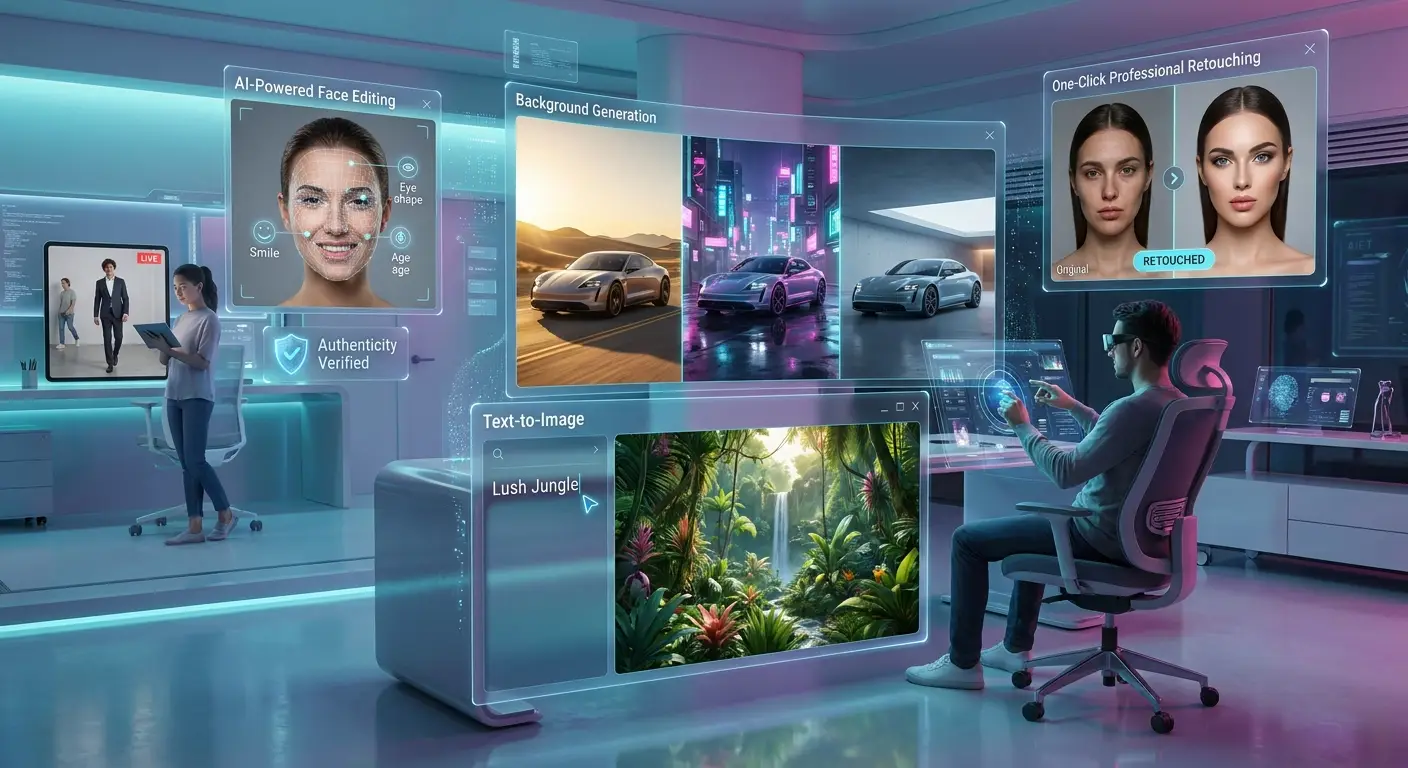
The future of digital creativity is being reshaped by rapid advancements in AI image editing tools, making professional-level visual creation faster, smarter, and more accessible. From automated enhancements to fully generated visuals, these trends are redefining how designers and creators work. Below are the most important developments driving this transformation.
Text-to-Image Creation Becoming Mainstream
Text-to-image AI is now a core feature in modern creative workflows. Instead of starting with a camera or design canvas, users can generate fully detailed visuals simply by describing them in text. This trend is accelerating the growth of generative AI photography, allowing marketers, artists, and businesses to produce custom visuals in seconds.
One-Click Professional Retouching
AI retouching software has evolved to deliver studio-quality edits with a single click. Skin smoothing, lighting correction, object removal, and color balancing are now automated, reducing hours of manual editing into seconds while maintaining professional standards.
AI-Powered Face Editing and Enhancement
AI face swap technology and facial enhancement tools are becoming more advanced, enabling realistic identity adjustments, expression tuning, and high-detail portrait improvements. While powerful, this trend also raises important discussions around authenticity and deepfake concerns in digital media.
Background Generation Instead of Background Removal
Instead of simply removing backgrounds, AI now generates entirely new environments that match lighting, depth, and subject positioning. This shift supports synthetic photography, giving creators full control over visual storytelling without reshoots.
Real-Time AI Editing
Real-time AI editing is emerging as a game-changer for video calls, live streaming, and mobile photography. Users can see instant enhancements, style changes, and object edits as they capture content, making creative adjustments seamless and immediate.
Will AI Replace Traditional Photo Editing
AI is rapidly transforming the editing landscape, but it is unlikely to fully replace traditional photo editing. Instead, it is reshaping the industry by automating repetitive and technical tasks while allowing humans to focus more on creativity, storytelling, and artistic direction. Modern AI tools already excel at background removal , object detection, color correction, skin retouching, and generative AI photography, delivering fast and highly consistent results that significantly speed up workflows. However, human editors still play a crucial role in making creative decisions, maintaining brand identity, and adding emotional depth and context that AI often cannot fully replicate. The future of photo editing will therefore be a collaborative relationship where designers act as creative directors and AI-powered image editing tools serve as intelligent assistants, combining efficiency with imagination.
This balance between automation and creativity is clearly highlighted in the AI vs Human comparison table above, which shows how both sides contribute differently but importantly to the evolution of visual content creation.
Feature / Capability | AI Image Editing | Human Photo Editing |
|---|---|---|
Speed | Extremely fast (seconds) | Slower (minutes to hours) |
Consistency | High, automated outputs | Varies based on skill |
Creativity | Limited to trained patterns | Highly creative and original |
Emotional storytelling | Weak | Strong |
Precision edits | Very high | High but manual |
Handling complex context | Limited | Excellent |
Cost efficiency | Low per task | Higher due to labor |
Scalability | Very high | Limited |
Key Insight: AI dominates efficiency and automation, while humans dominate creativity and narrative control.
Generative AI + Face Swap + Video Fusion: The Next Big Breakthrough
Generative AI is rapidly redefining how both images and videos are created by enabling machines to generate highly realistic visuals, scenes, and even entire narratives from simple text or image inputs, marking a major shift in creative production. At the same time, AI face swap technology has evolved to deliver increasingly realistic identity mapping, allowing faces to be replaced or modified in images and videos with impressive accuracy, though it still struggles with complex lighting, motion consistency, and fine facial expressions in real-world scenarios.
Another major breakthrough is image-to-video generation, where static photos are transformed into dynamic motion visuals, adding depth, movement, and storytelling elements that were previously impossible without full video production. However, these advancements also raise serious ethical challenges, particularly around deepfake concerns, misinformation, identity misuse, and consent, making responsible use and regulation a critical part of the future of generative AI in media creation.
How Generative AI Will Change Photography Forever
Generative AI is set to completely reshape photography by shifting it from a camera-dependent craft to a hybrid digital creation process powered by intelligence and imagination. Instead of simply capturing reality, photographers will increasingly create, enhance, and even fully generate visual scenes using AI tools. This transformation is already unlocking new creative and commercial possibilities that were previously impossible with traditional methods.Key Ways Generative AI Will Transform Photography:
Creating Photos Without Cameras
Generative AI enables users to produce fully realistic images without ever using a physical camera. Through text-to-image AI, creators can generate landscapes, portraits, and product visuals that look indistinguishable from real photographs, opening new possibilities for artists and marketers.
AI-Assisted Photography Workflows
Instead of replacing photographers, AI will increasingly act as a smart assistant in the editing and shooting process. From automatic framing suggestions to real-time enhancements and AI retouching software, photographers will be able to work faster and focus more on creative direction.
Synthetic Photos for Commercial Use
Brands are already using synthetic photography to create product images, advertisements, and lifestyle visuals without expensive studio shoots. This reduces costs while allowing unlimited customization of lighting, environment, and composition.
Virtual Photoshoots and Digital Models
Virtual photoshoots powered by generative AI allow creators to use digital models and fully simulated environments. This eliminates the need for physical locations or models while still producing high-quality commercial imagery for fashion, gaming, and advertising industries.
Emerging Technologies That Will Power the Next Generation of AI Image Editing
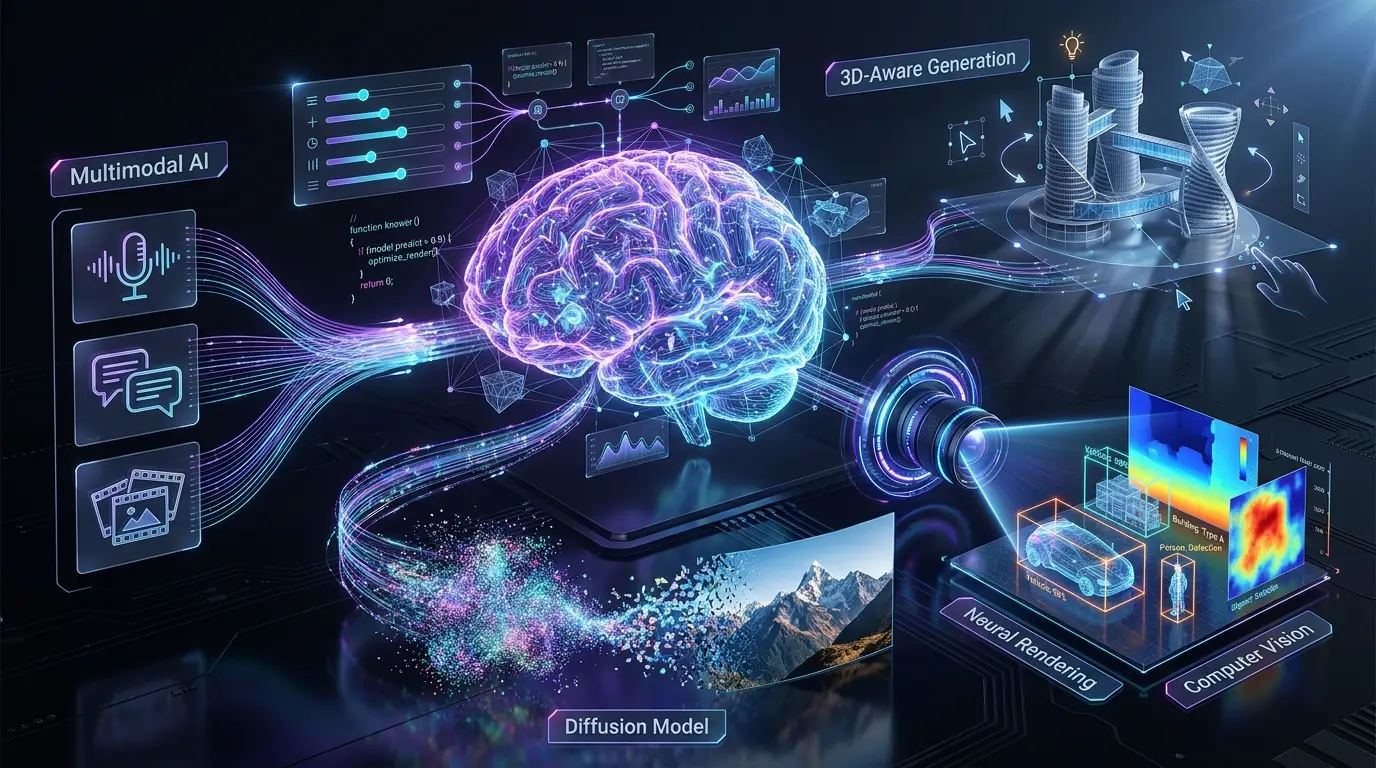
The next wave of innovation in AI image editing tools will be driven by a combination of advanced machine learning systems and next-generation visual computing technologies. These breakthroughs will make editing more realistic, interactive, and context-aware than ever before. Below are the key technologies shaping this transformation.
Multimodal AI Models
Multimodal AI models combine text, image, and sometimes audio inputs to understand content more deeply and generate more accurate visual outputs. This allows users to describe edits in natural language while the AI interprets context, style, and intent more intelligently.
Diffusion Models
Diffusion models are the backbone of modern generative AI photography, enabling the creation of highly detailed and realistic images by gradually refining random noise into structured visuals. They are responsible for the sharp improvement in quality seen in text-to-image AI systems.
Neural Rendering
Neural rendering uses deep learning to simulate lighting, textures, and camera effects, producing photorealistic scenes that closely mimic real-world photography. This technology is crucial for synthetic photography and advanced visual effects.
Computer Vision Advancements
Improvements in computer vision allow AI systems to better detect objects, faces, depth, and motion within images. This makes AI retouching software more precise and enables smarter editing decisions based on scene understanding.
3D-Aware Image Generation
3D-aware generation allows AI to understand spatial depth and structure, enabling consistent angles, lighting, and perspective changes. This is especially important for virtual photoshoots, gaming assets, and immersive digital environments.
Industries That Will Be Transformed by AI Image Editing
AI image editing is no longer limited to professional design studios—it is rapidly influencing multiple industries by making visual content creation faster, cheaper, and more scalable. From marketing visuals to immersive entertainment, AI-powered tools are reshaping how industries produce and use images. Below is a clear breakdown of the most impacted sectors. Impact of AI Image Editing Across Industries:
Industry | How AI Image Editing Is Transforming It |
|---|---|
Social Media Content Creation | Enables instant creation of high-quality posts, filters, and AI-generated visuals, improving engagement and consistency for creators and brands. |
Graphic Design | Automates repetitive tasks like background removal, resizing, and layout generation while boosting creative exploration through AI tools. |
Fashion | Powers virtual models, AI-generated clothing previews, and synthetic photography for faster product visualization and marketing campaigns. |
Real Estate | Generates realistic property visuals, virtual staging, and enhanced listing images without physical staging costs. |
Gaming | Supports concept art creation, character design, and environment generation for faster game development pipelines. |
Film Production | Assists in pre-visualization, CGI generation, scene editing, and digital effects, reducing production time and cost. |
Education | Creates interactive visual learning materials, simulations, and AI-generated illustrations to improve engagement and understanding. |
Challenges That Could Shape the Future of AI Editing
As AI-powered image editing continues to evolve, it also brings important challenges that will shape how the technology is developed, regulated, and used in the future. These issues are not just technical but also legal, ethical, and social in nature.
Copyright and Ownership Issues
Questions remain about who owns AI-generated content—the user, the developer, or the model itself—especially when training data includes copyrighted material.
Deepfake Regulations
AI face swap technology and synthetic media raise concerns about misuse, making stricter laws and detection systems necessary to prevent deception and misinformation.
Privacy Concerns
The ability to generate or manipulate realistic images of people raises risks around unauthorized use of personal data and identity replication.
Bias in AI Models
AI systems can reflect biases present in their training data, leading to unfair or inaccurate representations in generated or edited visuals.
Authenticity vs Artificial Content
As synthetic photography becomes more realistic, distinguishing between real and AI-generated content will become increasingly difficult, raising trust issues in media and advertising.
What Will AI Image Editing Look Like in 2030
By 2030, AI image editing is expected to become deeply integrated into everyday creative workflows, shifting from tool-based editing to fully intelligent, conversational, and automated systems. Instead of manually adjusting images, users will guide AI systems that understand intent, context, and style at a much deeper level, making visual creation faster and more personalized than ever before.Key Predictions for AI Image Editing in 2030
Voice-Controlled Editing: Users will be able to edit images using natural voice commands such as “make the background sunset” or “enhance lighting,” making editing more intuitive and accessible to everyone.
Fully Automated Design Workflows: AI will handle entire design pipelines—from concept creation to final output—automatically generating layouts, visuals, and variations based on user goals and brand guidelines.
Personalized AI Creative Assistants: Each creator will have a dedicated AI assistant trained on their style, preferences, and past work, enabling highly consistent and personalized visual outputs.
Instant Cross-Platform Content Generation: Content will be automatically optimized and generated for multiple platforms (Instagram, YouTube, websites) simultaneously, reducing manual resizing and adaptation work.
AI-Powered Visual Storytelling: AI will not only edit images but also build complete visual narratives, combining images, motion, and context to create immersive storytelling experiences for marketing, education, and entertainment.
How Businesses and Creators Can Prepare for the Future
As AI continues to reshape the creative industry, businesses and creators must adapt by developing future-ready skills, learning essential tools, and building efficient AI-first workflows to stay competitive. Skills such as creative direction, storytelling, and prompt engineering will become more valuable than traditional manual editing, as AI-powered image editing tools take over most technical tasks. At the same time, learning generative AI photography platforms, AI retouching software, and other AI-based creative tools will be essential for producing high-quality content quickly and efficiently.
By integrating AI into every stage of production, creators can build an AI-first content workflow that boosts productivity and creativity. Ultimately, staying competitive in an AI-driven market will depend on how well individuals and businesses combine human creativity with intelligent automation to deliver unique, impactful visual content.
Conclusion
The future of AI image editing is being shaped by powerful trends such as generative AI photography, AI face swap technology, text-to-image AI, and real-time editing systems that are redefining how visual content is created and consumed. These innovations are opening significant opportunities for businesses and content creators by making high-quality design more accessible, reducing production costs, and enabling faster creative experimentation at scale. However, despite these advancements, human creativity remains essential for storytelling, emotional depth, and artistic direction, ensuring that content still carries meaning beyond automation. Looking ahead, the future of image editing will be defined by a collaborative relationship between humans and AI, where intelligent tools enhance creativity rather than replace it, leading to a more efficient, imaginative, and visually dynamic digital landscape in the years to come.