
Paying for AI Tools With Crypto: Here’s What “Safe” Really Means
By Maria · 2026-08-30
Are crypto payments safe for AI tools? Learn how to verify the provider, asset, network, address, amount, confirmations, and refund options before paying.
You’ve found the AI tool you want, whether it’s for images, video, writing, or getting more done in less time. You’ve picked a paid plan, landed on the checkout page, and you’ve got USDT, Bitcoin, Ethereum, or another crypto sitting in your wallet. One question stands between you and hitting “pay”: can you safely pay for this AI tool with crypto? One question stands between you and hitting “pay”: can you safely pay for this AI tool with crypto?
Payment safety depends on several factors working together: the provider, the checkout, the asset, the network, and the transaction details. If any of these details is wrong—for example, if you use an unofficial payment link, select the wrong network, or enter an incorrect address—you may lose funds even if the transaction is successfully confirmed on the blockchain.
This isn’t a fringe use case anymore. In an October 2025 report, Stripe stated that its top 20 AI companies generated roughly 60% of their revenue outside the United States. This figure applies specifically to the companies included in Stripe’s analysis and should not be treated as a measure of the entire AI industry.
Summary
Paying for AI tools with cryptocurrency can be safe and convenient when you use the provider’s official checkout. However, crypto payments require extra attention because confirmed transactions are usually irreversible. Before sending funds, carefully review the payment asset, blockchain network, destination address, and amount.
Crypto payments can be safe when you use the provider’s official checkout.
Always verify the supported asset, blockchain network, destination address, and payment amount before sending.
A blockchain confirmation does not always mean that your AI subscription has been activated.
Confirmed crypto transactions are usually irreversible, so review every payment detail carefully before sending the funds.
Crypto Payments Aren’t an Experiment Anymore
Stablecoins moving value at scale isn't a hypothetical. Visa's onchain analysis puts adjusted stablecoin transaction volume at approximately $10.2 trillion over the trailing 12 months, up 63% year-over-year. Visa deliberately filters this figure to strip out high-frequency trading bots, certain smart-contract activity, and internal exchange rebalancing, so it's a more conservative read than raw blockchain totals.
Even so, this adjusted number isn't the same as consumer retail checkout spending. It's not accurate to say consumers spent $10.2 trillion with stablecoins. What Visa's data does show is the broader scale at which stablecoins are already moving value globally, across settlement, treasury operations, and cross-border transfers, well beyond speculative trading.
That scale shows up in how many wallets are actually using stablecoins, not just holding them. Visa also reported that more than 40 million addresses sent or received a stablecoin in July 2025, an all-time high at the time. Put together, the picture is less about crypto as a bet on price and more about stablecoins becoming a working rail for moving money, which is exactly the context that matters when you're deciding whether to pay for an AI subscription with one.
What Actually Makes a Crypto Payment Safe?
There’s no single switch that makes a crypto payment secure. Safety is a stack, and each layer in that stack solves a different problem.
Safety Layer | What It Means for the Buyer |
|---|---|
AI Provider | You’re buying from the intended service |
Official Checkout | Payment begins from the provider’s real website or account |
Supported Asset | The cryptocurrency matches what the checkout accepts |
Correct Network | Your wallet and the checkout use the same blockchain |
Correct Payment Details | Amount and destination address match the order |
Transaction Record | Payment can be independently verified after sending |
Account Security | Your wallet and account access stay protected |
Each of these layers does a distinct job. The provider layer confirms you’re dealing with a real business. The checkout layer rules out phishing pages and third-party links. The asset and network layers prevent funds from being sent to the right address on the wrong chain, a mistake the blockchain cannot undo. The payment details layer catches typos and amount mismatches before they’re permanent. The transaction record layer gives you proof. Account security protects everything above it from being bypassed at the access level.
A secure blockchain cannot choose the right subscription or network for you, but a well-designed checkout makes these details much easier to verify.
What Blockchain Security Actually Gives You
Once a transaction is broadcast, the underlying cryptography gets to work. Every transaction is validated by a distributed network using asymmetric cryptography: the sender’s private key signs the transaction, and the network confirms that signature is legitimate before adding it to the chain. No central party needs to approve it, and no single point can alter the record once it’s confirmed.
The result is a transaction hash, a unique identifier tied to every detail of that payment: the sending address, the receiving address, the amount, the timestamp, and the network fee. That hash is permanent and publicly searchable. Anyone can paste it into a block explorer—such as Etherscan for Ethereum-based transactions or Tronscan for TRC-20 transactions—and see exactly what was sent, when, and where.
Stripe describes stablecoin transactions as being recorded on public blockchains that are “traceable, and auditable,” which is an accurate summary of what that hash represents.
This matters practically. If a payment is ever disputed, the transaction hash is your receipt. It shows the exact amount sent, confirms the destination address, and records the block timestamp. Support teams at legitimate AI providers can verify all of this without you having to trust their internal logs alone.
That said, a few limits are worth being clear about. Not every blockchain offers the same security guarantees. Network maturity, decentralization, and validator-set size can vary significantly, and these differences can affect the reliability of a payment network. Blockchain-level integrity does not make every merchant trustworthy; it only means the payment record itself can’t be forged after the fact. Crypto transactions are not completely risk-free. Wallet compromises, phishing, and social-engineering attacks can occur outside the blockchain layer.
The honest framing: blockchain technology gives a crypto payment verifiable transaction integrity, not perfect safety. It’s a strong foundation, and what you build on top of it still matters.
Why Paying With Crypto Can Reduce the Need to Share Card Details
With a traditional card checkout, you’re handing over a set of reusable credentials: card number, expiry date, CVV. If that checkout page is compromised, phished, or simply stores your details insecurely, those same numbers can be reused elsewhere. A direct crypto checkout works differently. The buyer initiates a transfer from their own wallet, which means the transaction itself doesn’t require entering card credentials at all.
This is worth framing carefully. It’s not accurate to say crypto means you share no personal information — that depends entirely on the wallet, exchange, checkout flow, and account requirements involved. An exchange-linked wallet may still be tied to identity verification, and some checkouts collect an email or billing details regardless of payment method. What’s accurate is narrower and still meaningful: direct crypto checkout can reduce reliance on traditional card credentials during the payment itself, since there’s no card number or CVV changing hands in that transaction.
It’s important not to blur this into a bigger claim than it is. Sharing less card information is not the same as complete anonymity. The transaction is still recorded on a public ledger, and depending on the wallet or exchange used, it may still be linked to an identity. Privacy is a separate, more nuanced topic, and it gets its own detailed section later in this piece.
Is Crypto Safer Than Paying by Card?
The honest answer is that neither system is universally “safer” — they protect you in different ways, and each is better at different things. A card payment comes with dispute mechanisms and familiar consumer protections, but it requires you to hand over reusable credentials. A crypto payment removes that exposure but offers little room to undo a transaction once it’s confirmed. Comparing them on one axis misses the point.
Payment Consideration | Direct Crypto | Card Payment |
|---|---|---|
Card credentials shared | Not required for direct crypto payment | Usually required |
Blockchain transaction record | Yes | No |
Settlement | Can be rapid depending on network | Uses card/payment rails |
Transaction cancellation | Usually limited after confirmation | Dispute/cancellation mechanisms may exist |
Global wallet access | Potential advantage | Depends on card/bank availability |
Recurring billing | Depends on checkout | Commonly supported |
Refund | Merchant policy still matters | Merchant/card rules apply |
The table makes one thing clear: “safer” depends entirely on which risk you’re trying to reduce. Direct crypto checkout can significantly reduce the need to share card credentials, but it does not eliminate every payment or account-security risk.
If you’re more concerned about getting your money back when a provider underdelivers, a card’s dispute options may be more reassuring.
The useful question isn’t which payment system is universally safer — it’s which payment route is actually supported by this provider, and whether you can verify the transaction before you send it. That’s the practical standard, and it’s the one that keeps this comparison honest rather than turning it into a “crypto vs cards: winner” argument.
USDT, Bitcoin or Ethereum: Does the Crypto You Choose Affect Payment Safety?
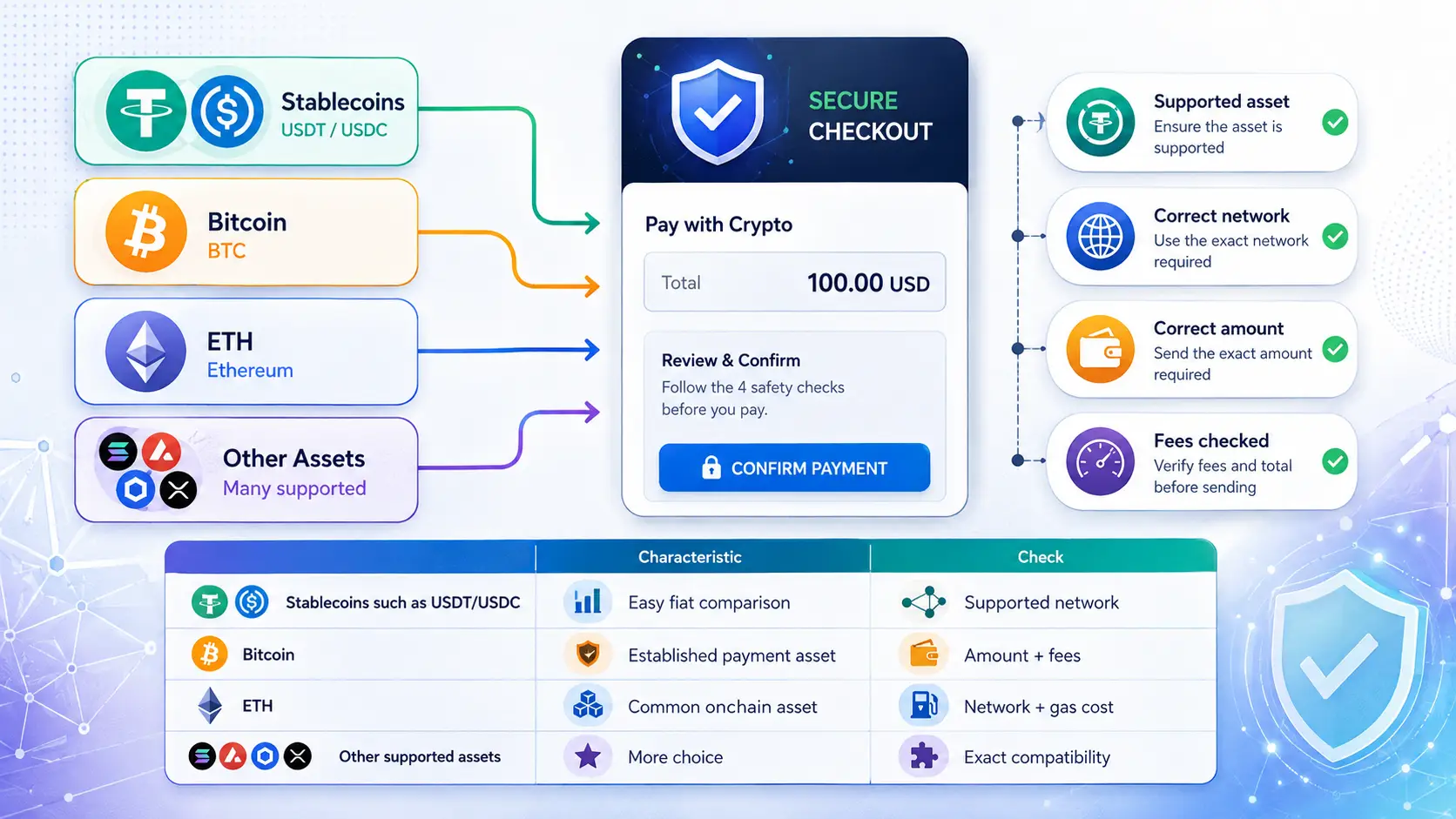
Buyers often ask this as if one asset is the “safe” choice and the others are riskier by default. In practice, the asset itself isn’t what determines safety — what matters is whether the checkout explicitly supports that asset on the right network, and whether the amount and fees line up with what you expect to pay.
Crypto Type | Useful Payment Characteristic | What Still Needs Checking |
|---|---|---|
Stablecoins such as USDT/USDC | Easier comparison with fiat-priced plans | Stablecoin + supported network |
Bitcoin | Established blockchain payment asset | Checkout support, amount and fees |
ETH | Common onchain asset | Network support and gas cost |
Other supported assets | Can provide additional choice | Exact checkout compatibility |
Stablecoins can make it easier to match a payment to a plan priced in dollars. For example, 20 USDT is generally intended to track approximately $20, although stablecoins can temporarily trade above or below their intended peg.
Bitcoin and Ethereum are widely supported and well-established as payment assets, but each comes with its own considerations — network confirmation times and fees for Bitcoin, gas costs and network choice for Ethereum. Other supported assets can offer more flexibility, but that flexibility only matters if the checkout actually accepts that specific asset on that specific network.
Key Answer
The safest cryptocurrency for a purchase is not automatically USDT, BTC or ETH. It is an asset the checkout explicitly supports on the correct network.
This isn’t a ranking of which cryptocurrency is the better investment or which one is likely to hold or gain value — that’s a separate question with no bearing on payment safety. The only ranking that matters here is compatibility: does the provider’s checkout support this asset, on this network, for this amount.
Why Stablecoins Can Feel Simpler at an AI Checkout
Most AI tools price their plans in dollars — $12/month, $20/month, $49/month. When you pay with an asset whose market price is moving, there's an extra mental step: you need to know what that asset is worth right now relative to the plan price, then send the right amount without overpaying or creating a shortfall.
A dollar-linked stablecoin removes that step. If a plan costs $20 and you're paying in USDT, the comparison is straightforward: the amount you send should be close to $20, the same way it would be with a bank transfer or card.
That practical simplicity is showing up in real payment behavior. Stripe reports that stablecoin-paying customers are twice as likely to be first-time customers on its platform — suggesting that stablecoin acceptance is reaching people who weren't being served by existing payment options, not just converting existing card users.
Understanding the Risks: Wrong Network vs. Wrong Address
It is critical to distinguish between these two common mistakes. While blockchain transactions are final, the likelihood of recovering your funds depends entirely on the nature of the error.
Sending on the Wrong Network: This happens when you send the correct asset through a blockchain that the provider does not support—for example, sending USDT on Ethereum when the provider accepts only USDT on Tron.
What happens: The funds technically arrive at the destination wallet’s address on the wrong blockchain. Since the provider’s system is only monitoring the correct network, it cannot “see” the payment.
Recovery: In some cases, if the provider has access to the private keys of that address on both chains, they may be able to help you recover the funds. However, this is not automatic. It requires manual intervention from their support team, can be time-consuming, and often involves a recovery fee. There is no guarantee of success.
Sending to the Wrong Address: This is a much more severe error, such as typing a random address or pasting an invalid one.
What happens: If the address is invalid (a format error), most modern wallets will block the transaction before it is sent. However, if the address is valid but belongs to another person, service, exchange, or wallet that you do not control, the funds may be extremely difficult or impossible to recover.
Recovery: If the valid address belongs to a known exchange, provider, or custodian, recovery may be possible if that organization is willing and technically able to return the funds. Otherwise, recovery is usually impossible.
The Bottom Line: Blockchain technology does not have a “recall” button. While some network-mismatch errors might be recoverable with professional support, there is no guarantee. Always treat every crypto transaction as irreversible—double-check the network and address before you confirm the send.
What Happens After You Click Send?
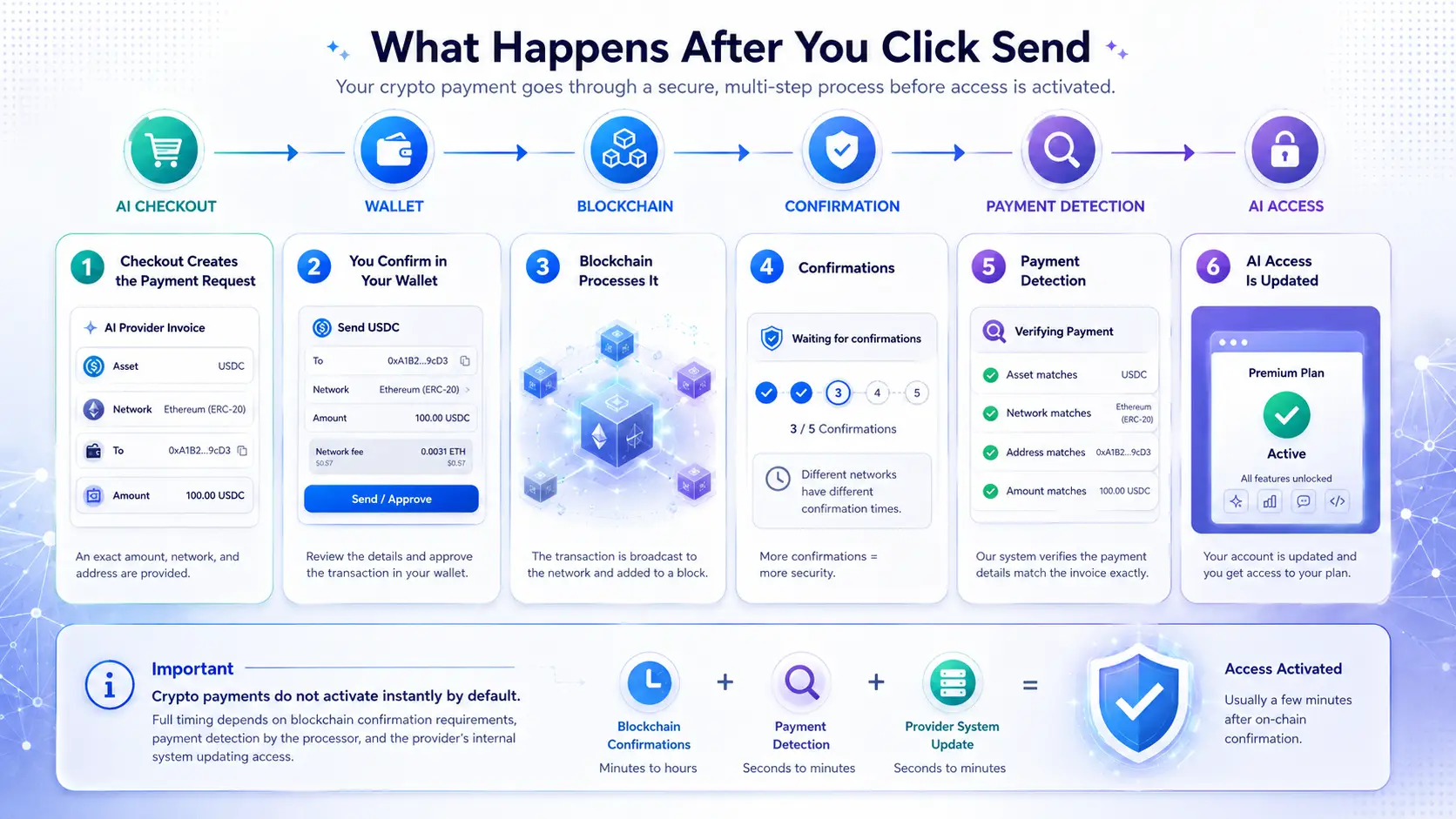
Once you confirm a crypto payment, it can feel like the transaction disappears into a black box. It doesn’t — there’s a defined sequence happening behind the scenes, and understanding it removes most of the uncertainty.
AI Checkout → Wallet → Blockchain → Confirmation → Payment Detection → AI Access
1. Checkout Creates the Payment Request
The AI provider’s checkout generates the payment details: the asset, the network, the destination address, and the exact amount due. This is the “invoice” the rest of the process depends on.
2. You Confirm the Payment in Your Wallet
After reviewing the asset, network, amount, and destination address, you confirm the transaction in your wallet. The wallet then broadcasts it to the blockchain network.
3. The Blockchain Processes It
The transaction enters the network’s confirmation process. Depending on the blockchain, this might mean waiting for one confirmation or several, and the time this takes varies by network — some settle in seconds, others take longer.
4. The Checkout Detects Payment
The provider’s payment processor checks whether the transaction matches the expected asset, network, destination address, and amount.
5. Access Is Updated
The provider’s system updates your subscription, plan, or purchase based on its own internal logic. This process is separate from the blockchain confirmation itself.
Important: Crypto payments do not activate instantly by default. How long the full journey takes depends on the network’s confirmation requirements, the processor handling detection, and how the provider’s infrastructure updates access on its end. A payment can be fully confirmed on-chain and still take a few minutes to reflect in your account, simply because of how the provider’s system checks and applies it.
How Do You Know a Crypto Payment Went Through?
After sending a payment, the natural next question is simple: did it actually work? With crypto, the answer isn’t always instant, and it isn’t always a single signal — it’s usually a combination of a few things lining up.
Here’s what genuine confirmation tends to look like:
Signal | What It Tells You |
|---|---|
Wallet shows the transaction as broadcast | The payment has left your wallet and entered the network |
A transaction hash/ID exists | There’s a unique reference you can use to track the payment |
Blockchain explorer shows the relevant status | The network itself confirms the transaction’s progress |
Checkout moves from pending/waiting to confirmed/paid | The provider’s system has recognized the payment |
Subscription or account access changes | The provider has acted on the payment, not just seen it |
A receipt or order status appears | There’s a record on the provider’s side, not just the blockchain’s |
No single one of these on its own is the full story. A transaction hash proves that a transaction was broadcast or recorded on the blockchain, but it does not by itself prove that the provider received, verified, or processed the payment correctly.
Transaction Sent ≠ Order Completed
This is the distinction that’s easy to miss, and it matters more than it sounds like it should.
“Transaction sent” generally means that your wallet broadcast the payment to the blockchain network. It does not necessarily mean that the transaction has been confirmed or processed by the provider.
“Order completed” means the provider’s system has received, recognized, and acted on that payment — usually by unlocking a subscription, updating an order status, or issuing a receipt.
These two moments can happen close together, or they can be separated by a real gap, for a few ordinary reasons:
Some networks require multiple confirmations before a transaction is considered final, not just one.
The provider’s checkout may wait for that finality before updating its own status, even if the blockchain shows the transaction as sent.
Account or subscription changes are handled by the provider’s system, which runs on its own timing — it isn’t instant just because the transaction was quick.
A transaction can therefore be valid and confirmed on the blockchain while the provider’s order system is still processing the payment. That’s not necessarily a sign of a problem — it’s often just the normal sequence of how confirmation works.
The practical takeaway: checking a blockchain explorer answers “did I send this correctly?” Checking your account or checkout status answers “did the provider act on it?” Both questions matter, and they’re not answered by the same signal.
Before You Pay: The 30-Second Crypto Checkout Check
Before sending the payment, complete these six quick checks:
Check 1 — Am I on the Official AI Provider?
Start the payment from the provider’s official site or logged-in account, not a link from an email, chat, or third party.
Check 2 — Is This the Plan I Want?
Confirm the plan, billing period, or credit package before moving forward.
Check 3 — Is the Cryptocurrency Supported?
Use whichever asset the active checkout actually lists, not one you assume it accepts.
Check 4 — Does the Network Match?
Match the wallet network to the checkout’s network. Never infer the network from the token name alone.
Check 5 — Does the Amount Match?
Compare the amount in your wallet against the amount shown at checkout.
Check 6 — Does the payment request match the current order?
Follow the payment details generated for this specific purchase, not a saved or reused address.
Memorable Summary
Provider → Plan → Asset → Network → Amount → Send
Six checks. One confident payment.
Is Paying for an AI Tool With Crypto More Private?
A direct crypto checkout can reduce the amount of traditional card information required during payment, although the exact data collected depends on the provider, wallet, exchange, and checkout process. That’s a real, concrete benefit.
The nuance worth knowing: many blockchain transactions create a public onchain record. So while less card data changes hands, crypto isn’t automatically anonymous.
Payment Privacy ≠ AI Data Privacy
Payment privacy concerns how the transaction itself is made.
AI data privacy concerns what happens to your prompts, images, videos, documents, account information, and generated content.
Paying with cryptocurrency doesn’t itself determine how an AI service handles what you upload or generate. That’s governed separately, by the provider’s own policies. Worth checking the provider’s Privacy Policy on its own terms, not assuming the payment method covers it.
5 Myths About Crypto Payments for AI Tools
To make the differences easier to scan, here’s a side-by-side comparison of what people often assume about crypto payments and what the actual situation usually is.
Myth | Reality |
|---|---|
Crypto payments are automatically unsafe | Legitimate providers can offer structured, verifiable crypto checkout |
The blockchain makes every checkout trustworthy | The merchant and checkout still need independent verification |
USDT is enough — you don’t need to check the network | Asset and network both have to match |
Crypto payments can never be refunded | The transaction itself isn’t reversible, but a merchant can issue a separate refund |
Paying with crypto automatically makes AI use anonymous | Blockchain payments may be publicly traceable, while the provider’s handling of AI data is governed by separate privacy policies. |
When Does Paying for an AI Tool With Crypto Make the Most Sense?
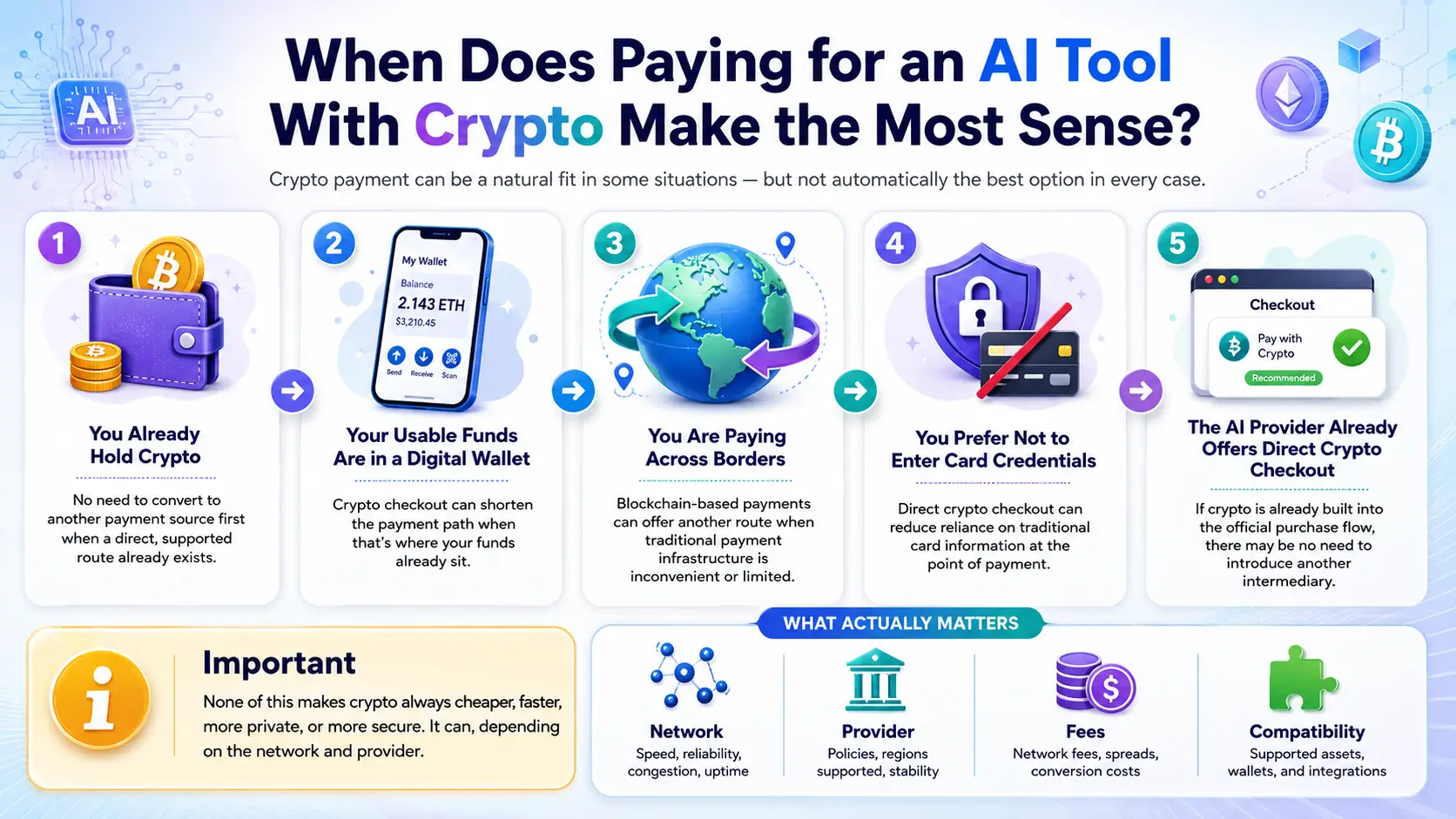
A few situations where it tends to fit naturally:
You Already Hold Crypto
No need to convert to another payment source first when a direct, supported route already exists.
Your Usable Funds Are in a Digital Wallet
Crypto checkout can shorten the payment path when that’s where your funds already sit.
You Are Paying Across Borders
Blockchain-based payments can offer another route when traditional payment infrastructure is inconvenient or limited.
You Prefer Not to Enter Card Credentials
Direct crypto checkout can reduce reliance on traditional card information at the point of payment.
The AI Provider Already Offers Direct Crypto Checkout
If crypto is already built into the official purchase flow, there may be no need to introduce another intermediary.
None of this makes crypto always cheaper, faster, more private, or more secure. It can, depending on the network and provider.
What a Real, Trustworthy AI Crypto Checkout Should Show You
Before sending any transaction, a thoughtful checkout should make the key payment details visible. The table below maps each detail you might see to why it matters for your payment.
Checkout Detail | Why It Helps |
|---|---|
Product/plan | Confirms what’s being purchased |
Purchase amount | Gives the buyer a value to verify |
Supported cryptocurrency | Prevents guessing |
Supported network (when relevant) | Establishes the correct payment route |
Payment request | Connects the transaction to the specific order |
Status | Shows whether payment is waiting, pending, or complete |
Order/reference information | Helps with support and later verification |
Not every checkout will present these details in the same layout — different payment processors design their UI differently. What matters is that the information is clear and verifiable, not that it looks the same everywhere.
Final Verdict: Are Crypto Payments Safe Enough for AI Tools?
Crypto can be a practical payment option for AI tools when the provider is legitimate, the payment begins through its official checkout, and the buyer verifies the supported asset, network, amount, and payment details before sending.
Trusted Provider + Clear Checkout + Correct Payment Details = Lower Payment Risk
Because crypto transactions are final once confirmed, those details deserve a quick check before sending, not after. But that’s a matter of a 30-second habit, not a reason for hesitation.
If you already hold cryptocurrency and want to use it to access AI tools, you can compare Betatum AI plans and follow the payment instructions shown on its official checkout page. Do not send funds to wallet addresses copied from unofficial sources.